| mlav.land | ||
| 2025 | strategy, tactics and trembling | talk |
| 2025 | xénotopies | platform |
| 2025 | dancing in free space | film |
| 2025 | great outdoors | installation |
| 2024 | docs.mlav.land | documentation |
| 2024 | unproject reweave | talk |
| 2024 | sucre noir | article |
| 2023 | the use of space, parts i & ii | film |
| 2023 | unproject reweave | article |
| 2023 | tuftcore | installation |
| 2023 | anonymous futures | film |
| 2023 | olympic forensics | workshop |
| 2023 | open oriented objects | design |
| 2022 | unproject | research |
| 2022 | supervision of degree theses | teaching |
| 2021 | no backup | performance |
| 2021 | image of the floating world | illustration |
| 2020 | host to host | article |
| 2020 | prehistories, access to open objects | research |
| 2020 | uncertainty and chaos | article |
| 2019 | measuring and piling, fiction and reality | installation |
| 2019 | random architecture program | platform |
| 2019 | actualization of heritage | article |
| 2019 | the iliad/free ecosystem in paris | illustration |
| 2019 | objects trump architecture | article |
| 2019 | the mobile micro-laboratory | design |
| 2019 | archives of terrestrial extracts | archive |
| 2018 | this is a story about dreams | film |
| 2018 | what it can be | installation |
| 2018 | auto-post-trans-multi-méta-néo-anti-sub-ob- | text |
| 2017 | the dive | film |
mlav.land is an autonomous architectural research-creation practice. It aims to explore, both spatially and mentally, ways of inhabiting and existing in a fractured world. This ongoing research seeks to strengthen forms of life that emerge in uncertain territories, as well as forms of attachment that are not based on ownership, but on use, care, and collective memory. This generative work of estrangement consists of unlearning what was once assumed to be self-evident, opening breaches toward other possibilities, coexisting with the unknown, and patiently shifting what is toward what could be.
| Publications | Exhibitions |
| Revue Polygone Plan L**** lundimatin Terrestres Revue du Crieur Pavillon de l'Arsenal |
Pavillon de l'Arsenal Cité de l'Architecture et du Patrimoine Villa Noailles Académie des Beaux-Arts Miroir de Poitiers EPFL Beaux-Arts de Paris Bap Versailles DNL gallery |
| Conferences/performances | |
| Ateliers Nocturnes École Normale Supérieure ENSA Paris Malaquais RAAAM École Zéro |
| contact@mlav.land | @mlav.land |
| Strategy, tactics and trembling | 27th of November, 2025 |
| Performed lecture |
At the École Normale Supérieure (Paris), as part of PSL Week organized by Mathieu Garling on cybernetics |
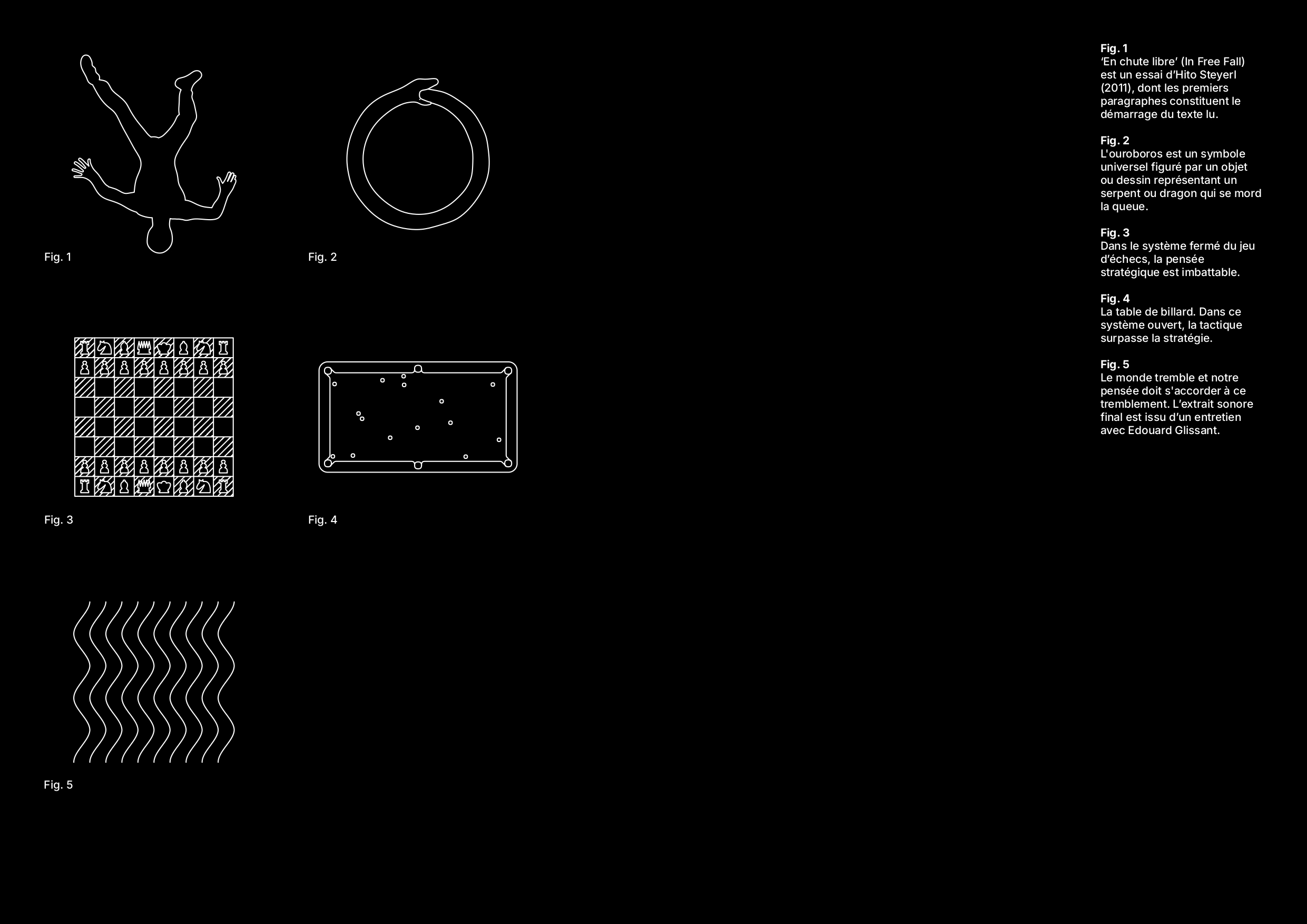
Strategy, tactics and trembling enacts a collective plunge into the “bottomless” — that state of permanent free fall in which our certainties, frameworks, habitual tools of orientation, and categories begin to waver.
By revisiting the legacy of cybernetics, which proposed understanding the world as a formal, calculable, measurable system, this performance seeks to highlight the radical limits of that logic. A system, however complex, remains closed and determined, incapable of accounting for life, accident, or emergence. Against the metaphor of the chessboard — a paradigm of strategy, planning, and anticipation — stands the billiard table: an unpredictable space of rebounds, micro-interactions, and tactical adjustments.
In a fragmented, trembling world marked by acceleration, the collapse of reference points, and climatic, social, and political instability, it is this tactical stance — this posture of assumed fragility, militant caution, and attentiveness to interstices and fragments — that becomes vital. The fall ceases to be a disaster; it becomes a milieu, the condition for a way of “living-with” disturbance and for situated action.
| xénotopies | 2025 |
| Online platform | xeno.mlav.land |
|
In collaboration with Nagy Makhlouf |
xénotopies is an exploratory project on ways of inhabiting and existing in a damaged world. It is a research initiative focused on sites of uncertainty, on forms of life that emerge within instability, and on modes of attachment grounded not in ownership but in use, care, and collective memory. It seeks to unlearn what once appeared self-evident, to open breaches toward other possibilities, and gradually to shift what is toward what could be.
Today, xénotopies takes the form of a blog dedicated to collecting and disseminating alternative approaches to architectural practice. Its publication schedule is irregular. To receive an email notification each time a new post is published, sign up here.
Articles published so far include contributions by authors such as Keller Easterling, McKenzie Wark, Patricia Reed, Franco Berardi, Clément Willer, l'Internationale Destructioniste, and Aidan Tynan.
| Dancing in Free Space | 2025 |
| Short film, 7 minutes |
Exhibited at the DNL gallery, Paris |
|
In collaboration with Erosion |
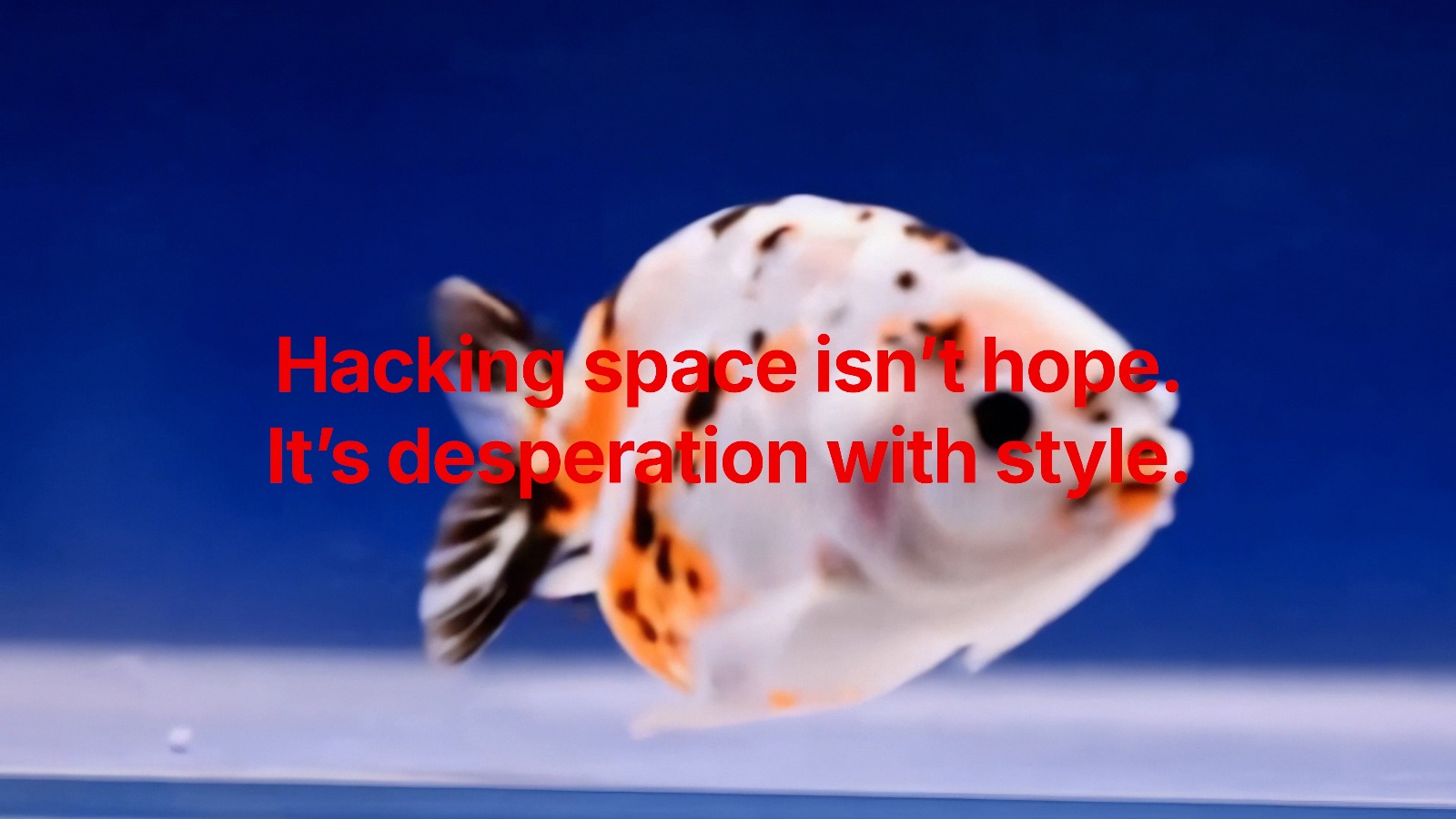
Dancing in Free Space is a visual reflection on the symbolic exhaustion of constructed space. Set against a backdrop of dark techno, the film advances a quiet hypothesis: when signs collapse, only use remains. Each sequence juxtaposes an architectural aphorism with the image of a fish, generated by a computational automaton and confined within an aquarium. These fish duplicate themselves, pass through the glass, and slip beyond the frame — aesthetic anomalies that evoke the glitches of a saturated spatial system.
Rather than unfolding as a linear narrative, the project operates as a critical drift through the spatial logics of late capitalism. It approaches architecture no longer as language but as apparatus: what remains when intention has dissolved, when founding narratives no longer hold. Space is presented as programmed inertia, an interface of control, a machine that converts gestures into data.
The film does not envision a revolutionary architecture; it exposes faults, loops, and minimal acts of reappropriation. Free Space is not a promise but a glitch — a residual space temporarily released from optimization.
| Great Outdoors | 2025 |
| Installation and narrative device |
Exhibited at the Bap 2025 (Versailles) |
|
In collaboration with UHO |
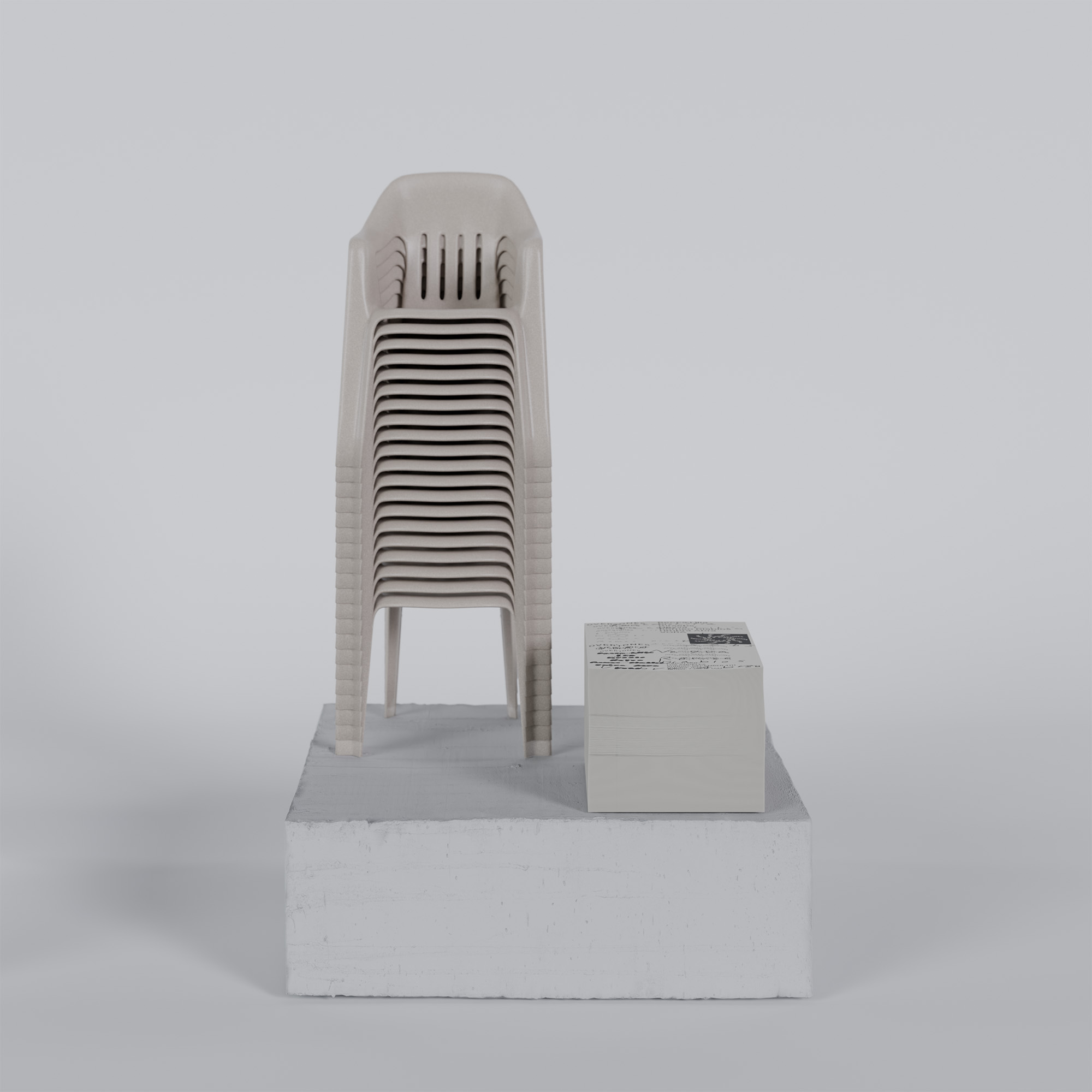
The installation takes as its point of departure the monobloc plastic chair, a globalized, standardized object emblematic of tropical regions. Designed at low cost for ephemeral use, it embodies the material legacy of the petrochemical industry. Difficult to recycle and often discarded, it becomes here the central element of an urban and climatic fiction. A stack of twelve chairs forms the core of the installation, accompanied by 4,000 posters distributed to the public.
These texts explore a post-heatwave city, suffocating, where plastic is no longer waste but infrastructure. The chairs become supports for an economy of use, a logic of sharing, and a memory of the body. Their discreet yet persistent presence composes an informal cartography, revealing resilient practices and tactical networks of survival.
The project examines the mutation of objects under extreme climate conditions, the organic adaptation of artifacts designed for obsolescence, and the urban forms that emerge from use rather than from planning. It questions how toxic, fossil-based materials are reterritorialized within local dynamics of care, temporary appropriation, and quiet resistance.
| docs.mlav.land | 2024 |
| Online documentation | docs.mlav.land |
This online documentation is grounded in a logic of radical openness, counter to dominant practices that separate disseminated objects from the processes that produce them and render those processes invisible. Rather than sacralizing the forms produced, it seeks to unfold the concrete conditions of their elaboration, based on the idea that a genuinely shared technique is a transmissible one — and therefore open to politicization.
Conceived as a digital commons, this resource base is organized into three layers: References (the theoretical and critical foundation, continuously evolving, that informs our positions); Processes (the tools, scripts, languages, and protocols employed and sometimes created for our practices); and Generations (the forms produced — films, installations, texts — understood not as ends in themselves, but as effects of situated work).
docs.mlav.land does not propose a model. It is an open toolkit, available for appropriation, transformation, and reciprocity. An invitation to recognize that knowledge is not an asset, but a support to be shared in order to collectively construct other forms of action.
| Unproject Reweave | 19th of April 2024 |
| Lecture |
Ateliers Nocturnes, La Cambre Horta Faculty of Architecture (Brussels) |
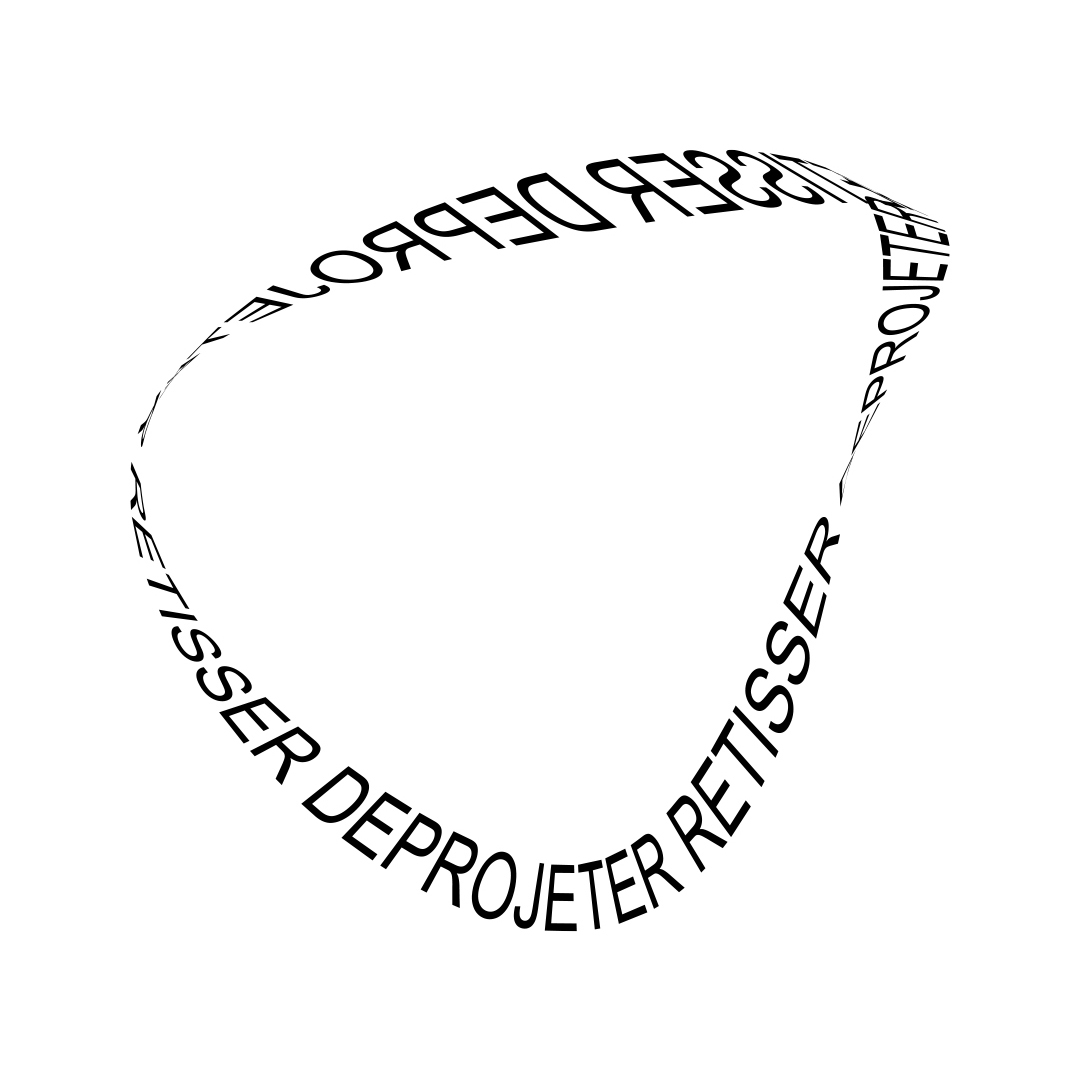
Unproject, Reweave is a lecture conceived as a methodological manifesto, articulating a series of projects, references, and critical positions around two gestures: that of unprojecting — unlearning, dismantling, or disorienting our habitual ways of making projects — and that of reweaving, as an attempt at sensitive, political, and situated recomposition.
The presentation traces a path through several works produced since 2018 — installations, writings, textile artifacts — understood as markers of a tentative trajectory within the field of contemporary architecture.
Beyond the sharing of experiences, the lecture seeks to bring forth an open “meta-method,” capable of connecting isolated practices and offering tools for analysis, creation, or action. Conceived as a ribbon to be unrolled, Unprojecting, Reweaving explores the possibility of a desirable future by acknowledging the crisis and sketching ways of working with it.
| Sucre Noir | 2024 |
| Article |
Published in Plan L**** #206 |
Download the article (French version)
“It is a very strange game in which everyone believes they know the rule and the reason, believes themselves to be the main agent, and yet does nothing but deny the world-board that surrounds them, shapes them, and constitutes the only answer to their blind quest.”
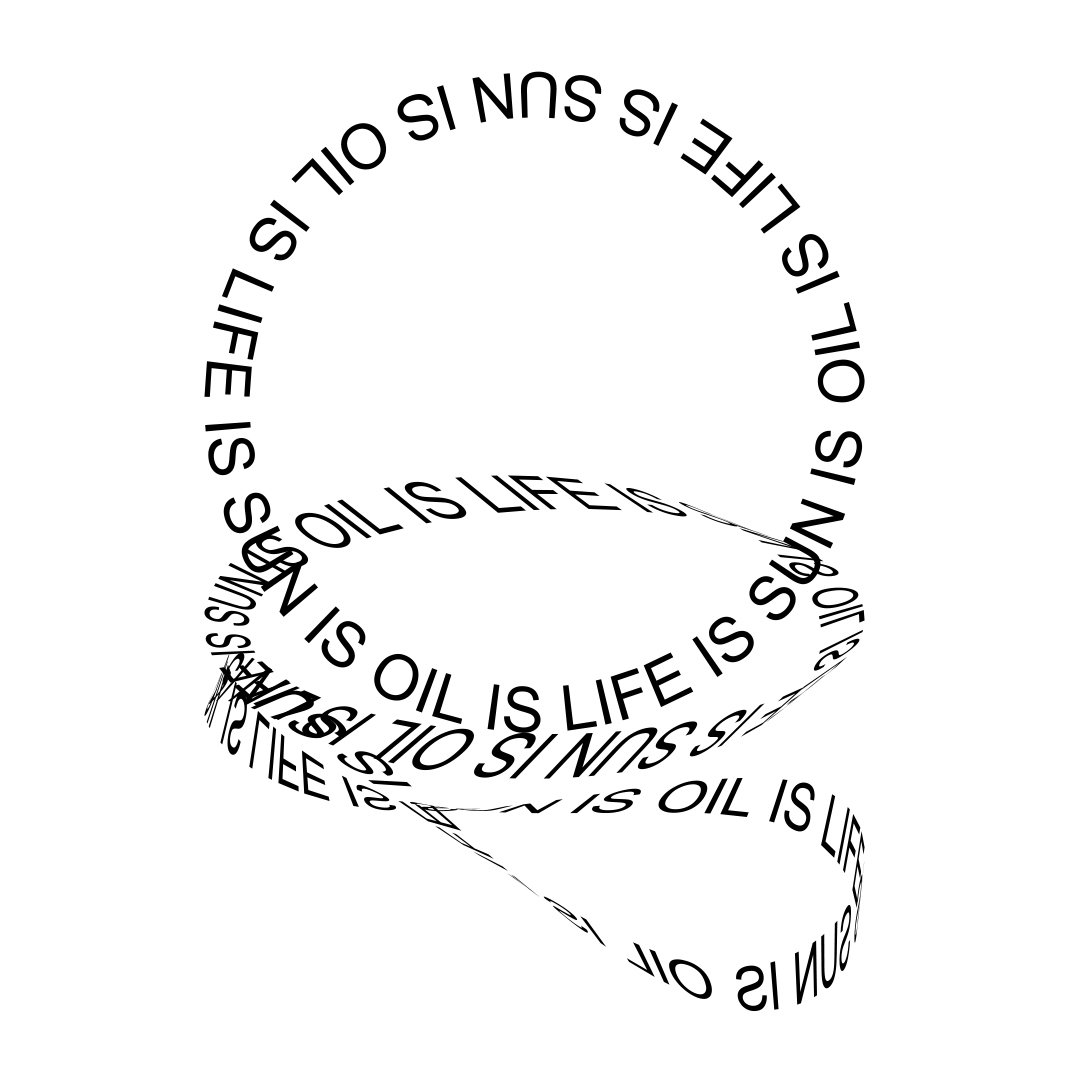
Sucre Noir (Black Sugar) explores our dependence on fossil fuels through a critical approach that intertwines scientific data, poetic narrative, and architectural theory. The text questions the illusory power conferred by oil — “black sugar” derived from millions of years of fossilized life — and brings to light the existential cost of this addiction.
At the intersection of essay and poetry, the article invokes the notion of “unproject,” formulated by Alessandro Mendini in 1976, as a conceptual lever in the face of ecological urgency. To unproject is to refuse the constant addition of more, and to imagine a future in which creating also means decongesting, simplifying, disarming. It is no longer merely a matter of designing the world, but of unlearning how to constrain it — of stepping outside the productive cycle inherited from fossil fire.
| The Use of Space, parts I & II | 2023 |
| Short film, 13 minutes |
Exhibited at the Académie des Beaux-Arts (Paris) |
|
Upon UHO's invitation |
The book The Use of Space, written by Max Turnheim, draws on the argument developed by Walter Benjamin in The Work of Art in the Age of Mechanical Reproduction, according to which architectural constructions are subject to a dual mode of reception: touch and sight.
Max Turnheim’s reading reformulates this observation through the diptych of use and information. In doing so, he seeks to demonstrate the loss of architecture’s visual and informational power in the face of the force exerted first by writing and later by digital media, while opening up reflections on the role of the architect in light of this shift.
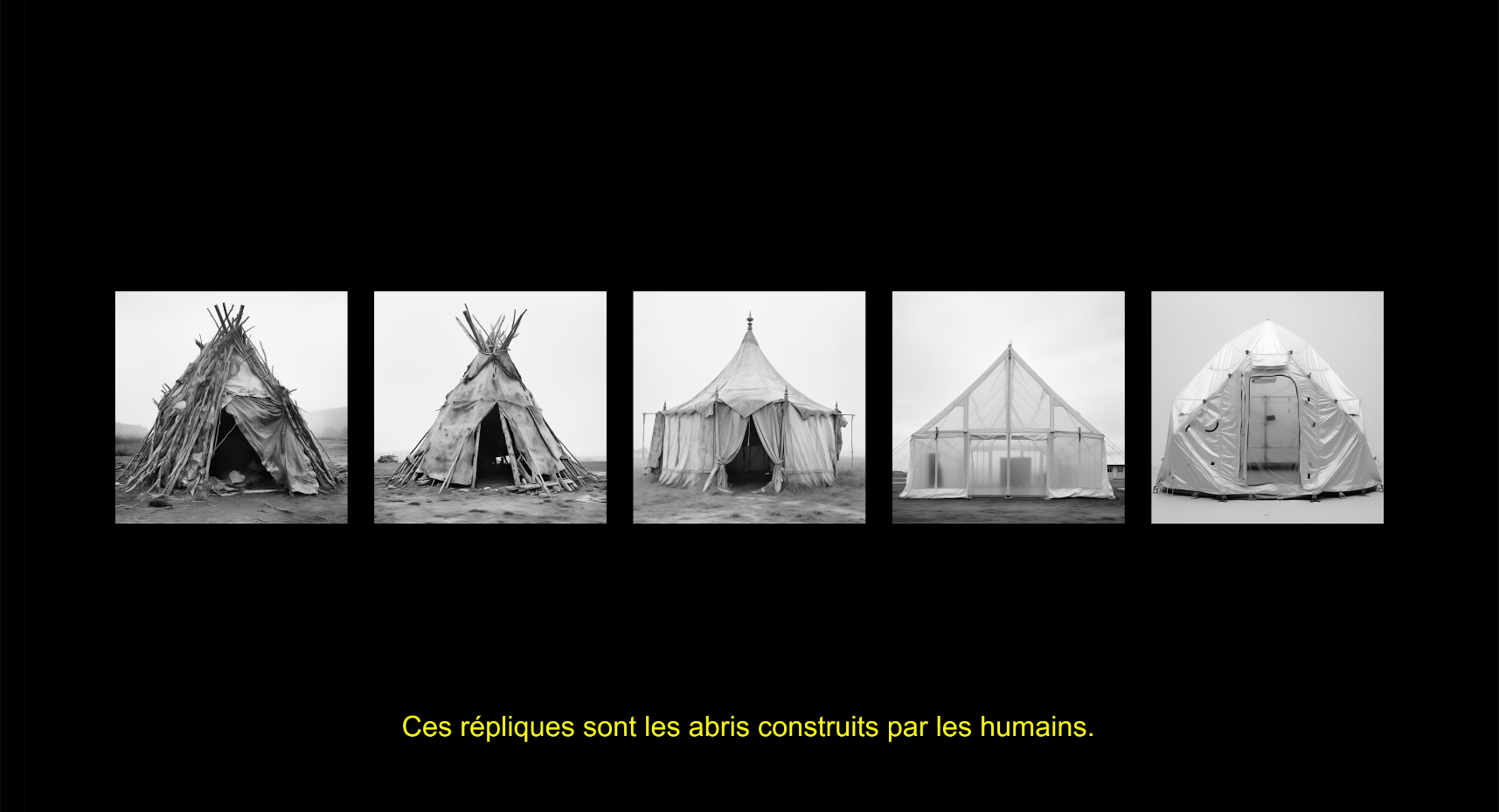
Drawing on found footage, 3D models, scans, archival documents, and generated images, we produced this short film as an introduction to the book’s argument, adopting a narrative format akin to documentary.
| Unproject Reweave | 2023 |
| Slogan |
Published in Plan L**** #204 |
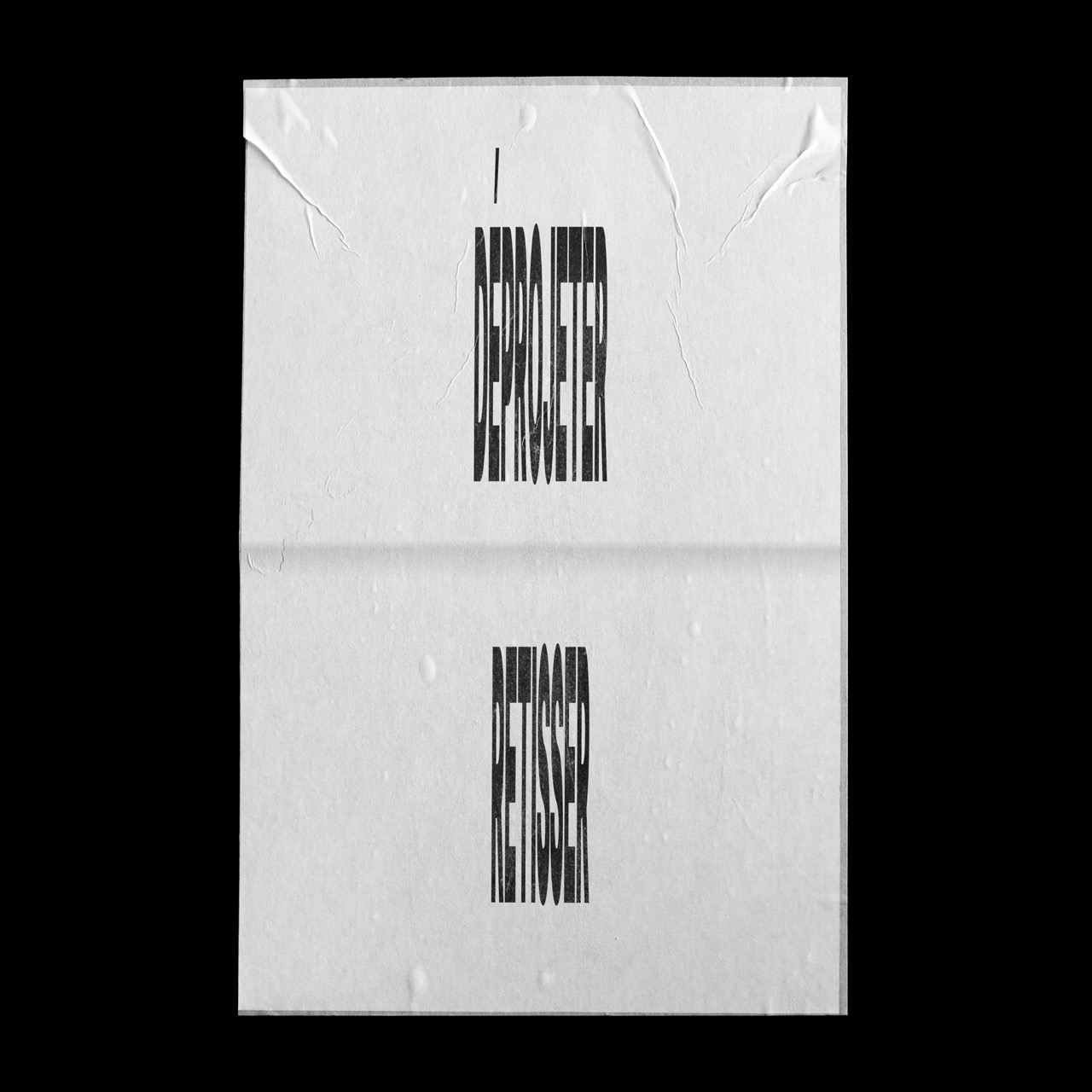
Issue #204 of Plan L*** magazine invited its contributors to present a slogan representing their architectural practice.
Following our explorations of the notion of unprojecting, we naturally foregrounded this necessity to unproject, complemented by a second gesture: reweaving. For us, this dual movement of unprojection and reweaving constitutes a pertinent and radical way of practicing architecture. To unproject is to break the apparent self-evidence of something that is not self-evident at all — of a projection that is neither immutable nor unquestionable, and that must be challenged in order to enable other ways of acting and living. It is to detach our representation of the world so that it may follow another voice/path. To reweave is to work with what is already there: to repair it, to care for it, to create connections and thereby meaning. This form of sobriety in architectural practice implies an economy of means and materials, responding to contemporary environmental and social concerns.
The stretching of the letters that compose the slogan invites the reader to unproject and decenter their own gaze. To make the text legible, one must shift from a frontal position to an oblique viewpoint, skimming across the page.
| Tuftcore | 2023 |
| Installation |
Exhibited at the Villa Noailles (Hyères) |
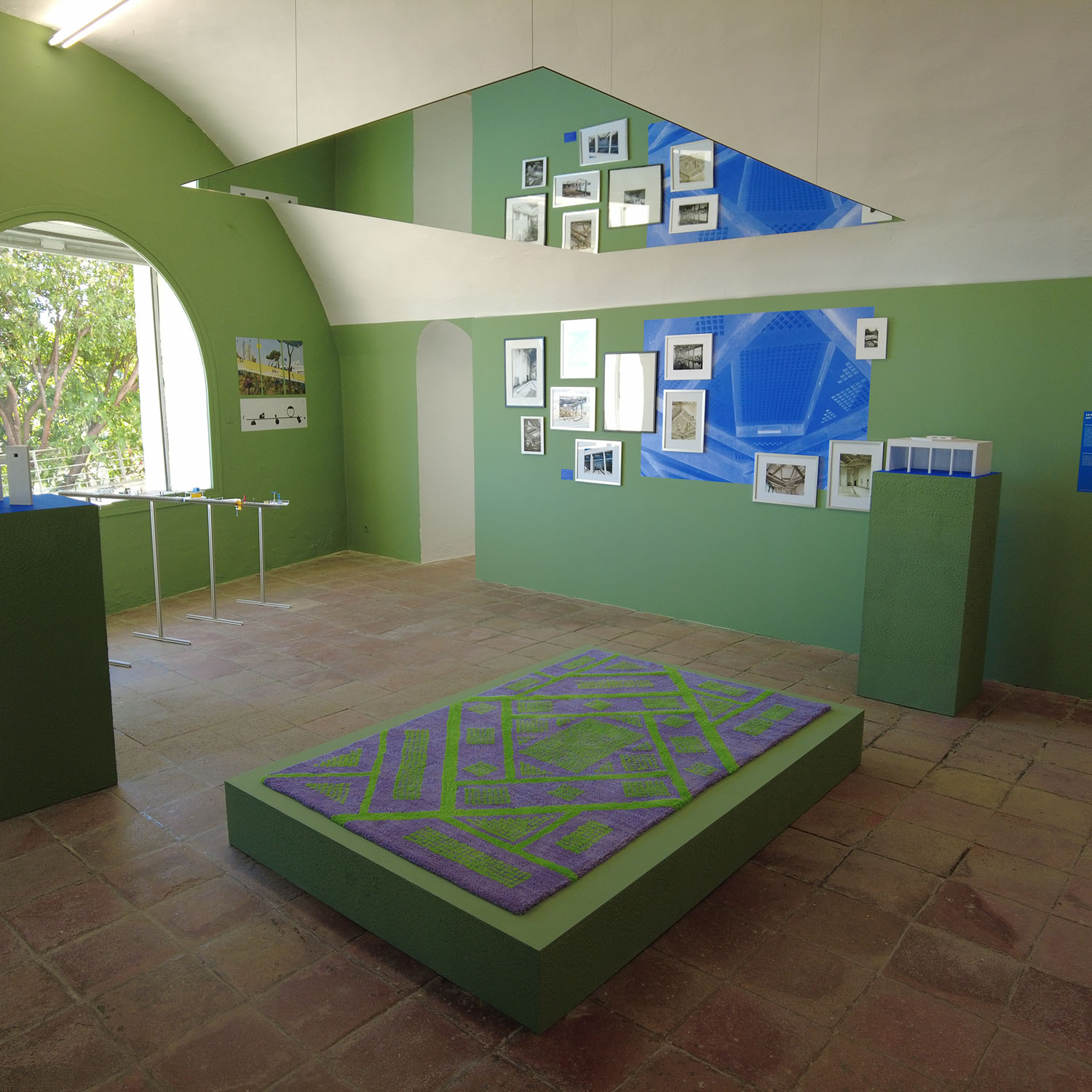
On the occasion of the centenary of the Villa Noailles, the exhibition proposal by MBL Architectes invited participants to reinterpret one of the ten architectural elements representative of the Villa. Our contribution developed an interpretation of the swimming pool ceiling.
The Villa Noailles pool became emblematic as a site of bourgeois and artistic representation. Bodies were staged there in the act of sport, aligned with the hygienist aspirations of the period. The beams, rotated at 45 degrees and intended to absorb the room’s reverberant acoustics, hover above the reflective surface of the water. Everything is mineral, white, modern, “neutral.” The author of this ceiling remains unknown; it may have been the project architect for Robert Mallet-Stevens, Gabriel Guévrékian, possibly drawing inspiration from Oriental carpets.
The installation consists of two facing planes. One is a carpet reproducing, in reverse, the ceiling’s motifs; the other, a suspended mirror reflecting it, thereby reconstructing the original pattern. The pool ceiling is thus disoriented and inverted. Its materiality becomes animal, colored, warm, and absorbent, while reclining bodies are reflected in the mirror above them. The staging borrows codes from contemporary pornographic representations of the body.
| Anonymous Futures | 2022-2023 |
| Illustrations, short film, 10 minutes |
Premiere at 'By Machines Of Loving Grace', organized by vista.report |
Download the script (French version)
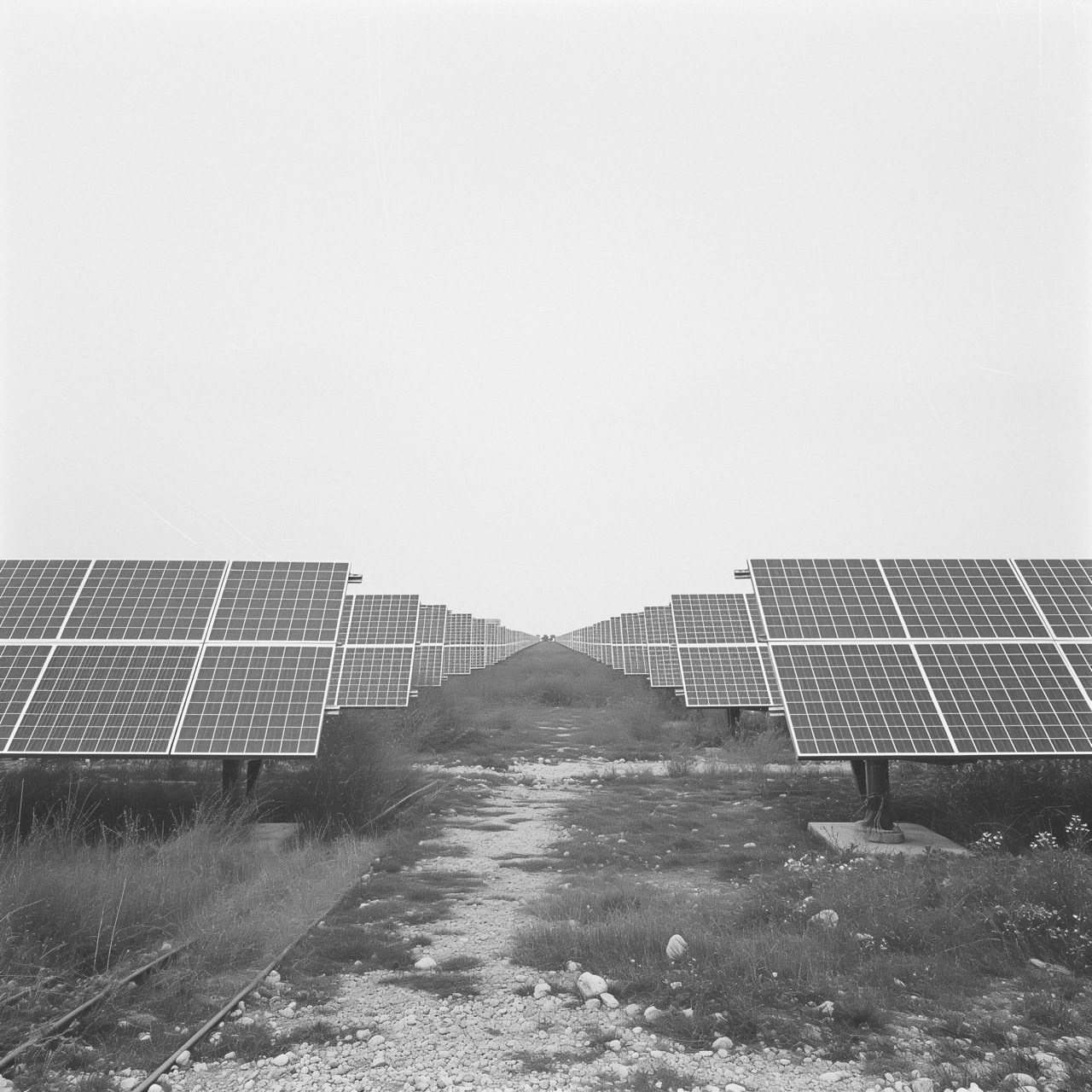
In the 1960s, Hilla and Bernd Becher methodically photographed an industrial heritage destined to disappear. Frontal views, black and white, blank skies: their documentary approach revealed the formal power of purely functional structures. Their 1970 publication titled these objects Anonymous Sculptures.
Anonymous Futures situates itself within this lineage while reversing its premise. Rather than archiving a world in the process of vanishing, the project explores negative commons — present or forthcoming ruins — through fictional images produced by a computational automaton.
The accompanying film stages two forms of zombie technologies: those embodied by the objects themselves, persistent waste from a bygone world; and those governing their fabrication, simulacra generated by computational systems. Anonymous Futures operates as a zombie counterpart to the work of Hilla and Bernd Becher.
| Olympic Forensics | 2023 |
| Workshop |
Organized as part of the MOB seminar at the École Normale Supérieure |
The MOB — a research group on the ontological furniture of the city — operates at the intersection of philosophy and architecture.
Hosted at the École Normale Supérieure (Ulm), it brought together doctoral researchers in the humanities and architects around a long-term inquiry, forensis 2024, devoted to the urban event constituted by the construction sites of the 2024 Olympic and Paralympic Games in Paris and Seine-Saint-Denis.
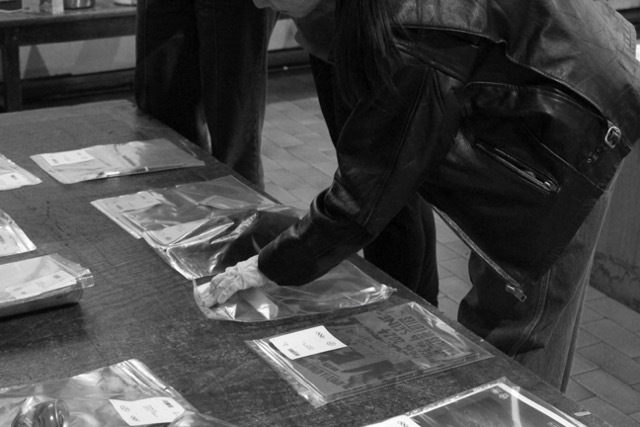
Who killed the Olympic Games? This was the enigma proposed for resolution during a three-hour forensic workshop. In a distant future, participants would look back in astonishment at the fact that the Paris 2024 Games were the last in history. Why? The reasons remain obscure.
Participants were appointed “commissioners²” — both criminal investigators and exhibition curators. As such, they were tasked simultaneously with investigating the disappearance of the Games and presenting their findings. Working in teams, they had to carefully handle clues, identify suspects, assemble evidence, and ultimately present their inquiry in the form of an exhibition, which they defended in a final prosecutorial argument.
| Open Oriented Objects | 2023 |
| Design |
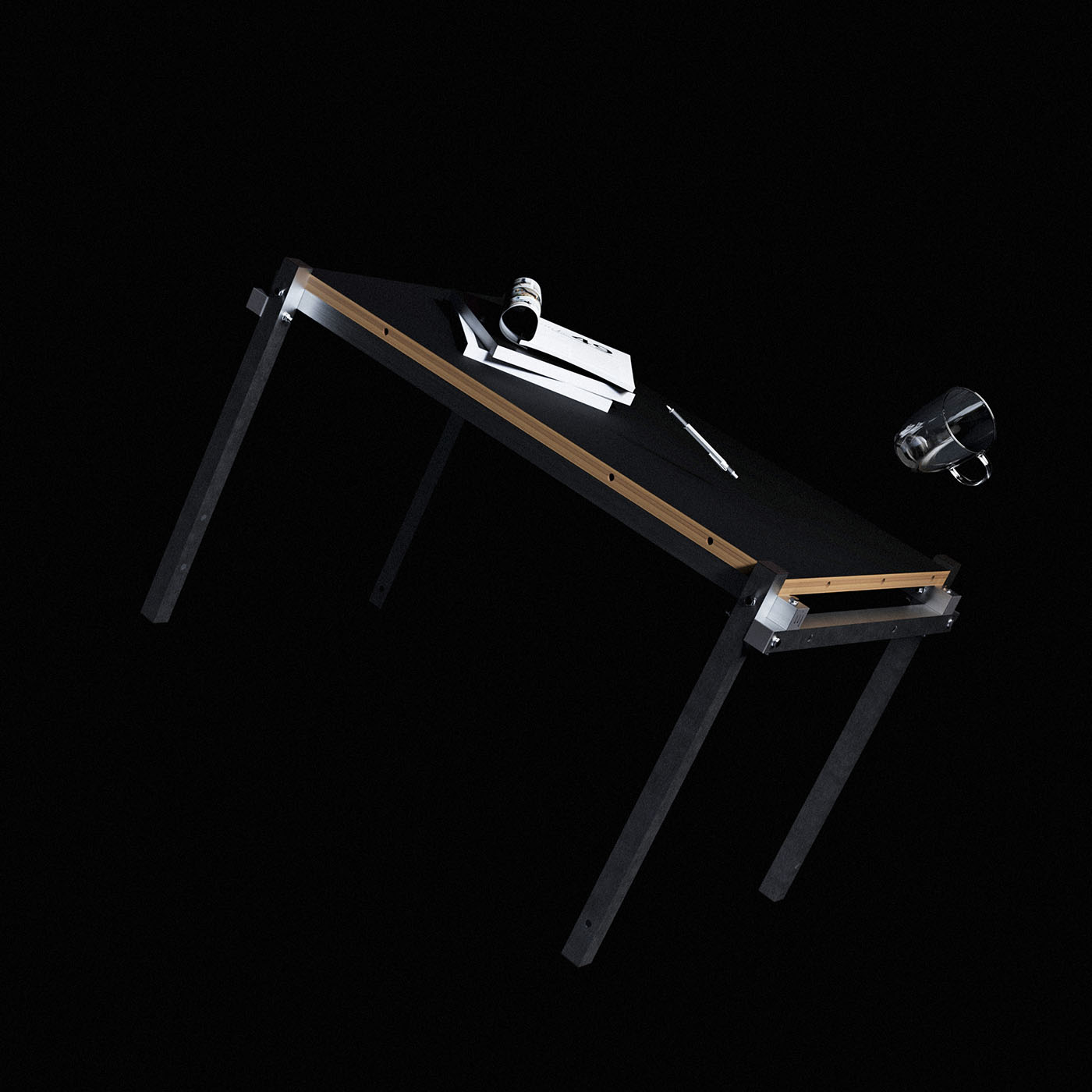
Open Oriented Objects is a series of furniture pieces designed to be fabricated from reclaimed materials, and to be easily dismantled, repaired, and recycled. Each object operates as a critical gesture against extractive industry and planned obsolescence.
By making public the plans, fabrication methods, and carbon data of each piece, the project adopts an open-source approach that refuses technical dispossession. In the spirit of Enzo Mari and his project Autoprogettazione?, and in continuity with Victor Papanek, the aim is not merely to propose forms but to transmit autonomy, reactivate collective know-how, and challenge the design industry’s monopoly over furniture production.
In a world marked by material and ecological depletion, producing differently is no longer sufficient. It becomes necessary to unlearn the reflexes of industrial comfort and to repoliticize our ways of inhabiting. These objects are modest explorations within the damaged terrain of domestic life — attempts to reopen possibilities in the face of resource exhaustion, industrial standardization, and the dispossession of everyday gestures.
| Unproject | Since 2022 |
| Research |
Unpublished |
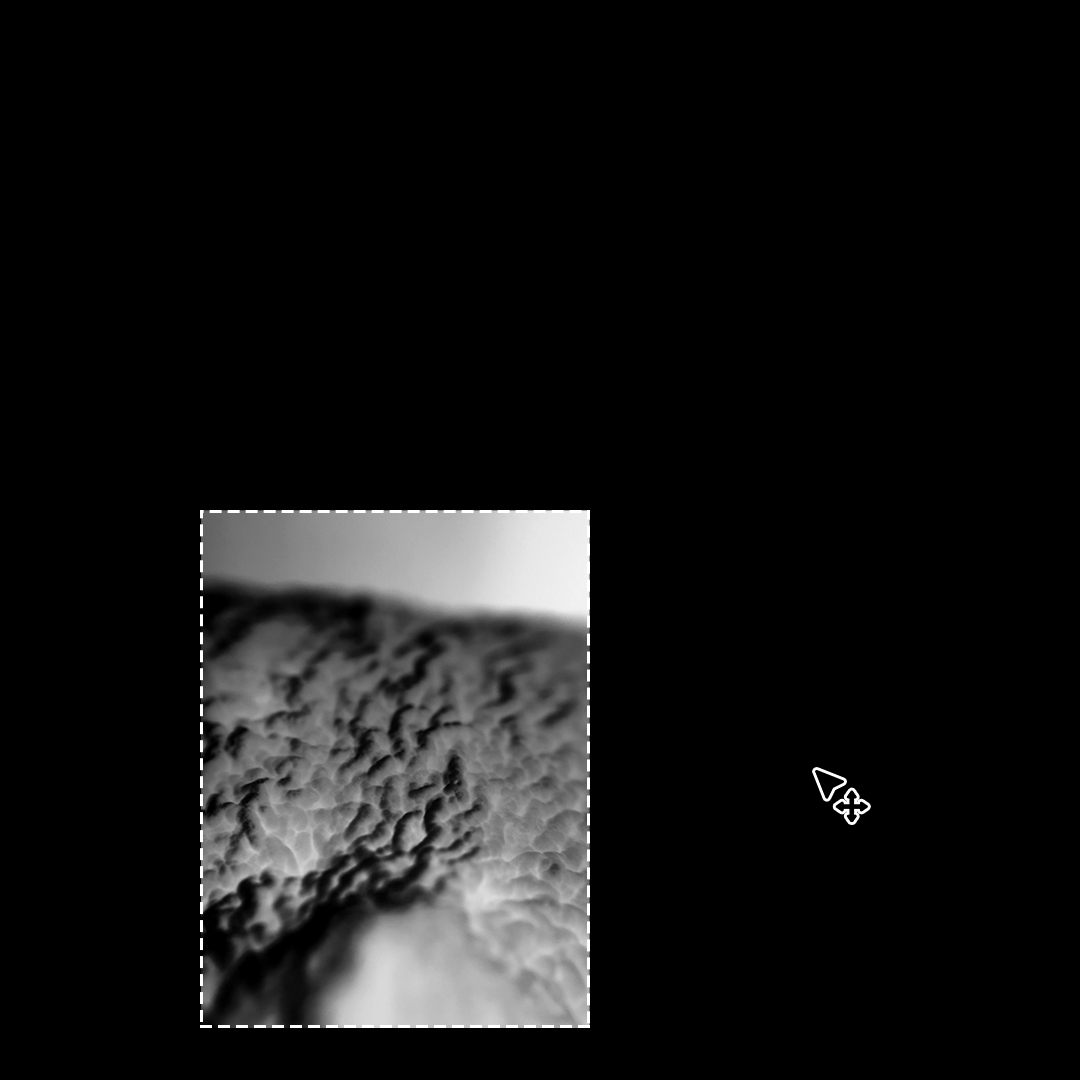
“Beyond a certain limit, history, technique, and the language of projection must be reversed: instead of projecting, we must un-project the world. We must introduce the negative notion of UN-PROJECT. The un-project is the project conceived in reverse: instead of increasing the quantity of information and matter, the un-project removes it, reduces it, mimics it, simplifies it, rationalizes obstructed mechanisms. The un-project is a decongesting creation, which does not have architectural form as its objective.”
— Alessandro Mendini, “Notion de déprojet,” Casabella, Year XL, no. 410, February 1976.
The notion of un-project proposed by Alessandro Mendini in Casabella in 1976 resonates strongly with the challenges currently faced by the architectural profession, and more broadly by anyone engaged in the act of designing.
Whether described as the Anthropocene, Capitalocene, Chthulucene, or Plantationocene, the present era confronts us with the necessity of reinventing our modes of production and, in order to do so, of identifying the theoretical supports that make such reinvention possible.
We cannot transition to an ecological mode of production without transforming our ways of living, creating, and projecting. To reconsider the possibilities of making a project is, first and foremost, to un-project the world: to break the frame, to crack the shell that encloses and constrains our modes of thought and action. To un-project is to dismantle what appears self-evident but is not — to question a projection that is neither immutable nor neutral, and that must be challenged in order to enable other ways of acting and living. It is to detach our representation of the world so that it may follow another voice/path.
The concept of un-project carries a radical potential that deserves to be developed into a framework grounded in history yet oriented toward future possibilities. It offers the capacity to identify points of convergence among diverse contemporary currents of thought and struggle.
To conceive the future of our built projects also means identifying the negative commons they will generate. More often than not, we construct future ruins destined to fill landfills rather than archaeological remnants. We must ask what kind of artificialization of the world we are projecting, and what space we leave for the nonhuman. Likewise, we must consider how to welcome and care for the diversity that exists within humanity itself.
Un-project, understood as a critical and operative concept, may provide the counter-imaginary necessary for the creation of a desirable and inhabitable future.
| Supervision of degree theses | 2022 |
| Teaching |
ENSA Paris Malaquais, PASS department |
At a time when climate urgency is redefining the responsibilities of the architectural field, future architects are invited, through their diploma projects, to engage directly with what already exists. Their approach does not seek erasure but transformation: reinvesting abandoned territories, diverting the uses of obsolete objects, and revealing overlooked material reserves.
The written theses accompanying final projects have fostered critical reflections on resource depletion. Students have experimented with forms of intervention that are sober, adaptive, and site-specific. Each proposal involved a critical reading of context, the sharing of knowledge, and close attention to what is already present.
Through these sites of experimentation — whether pedagogical, productive, or collective — graduates have articulated a clear stance: that of an architect who designs with limits, builds with remnants, and constructs narratives from what once appeared unusable.
| no backup | Since 2021 |
| Live performance |
2021-22 : Garompola Residence |
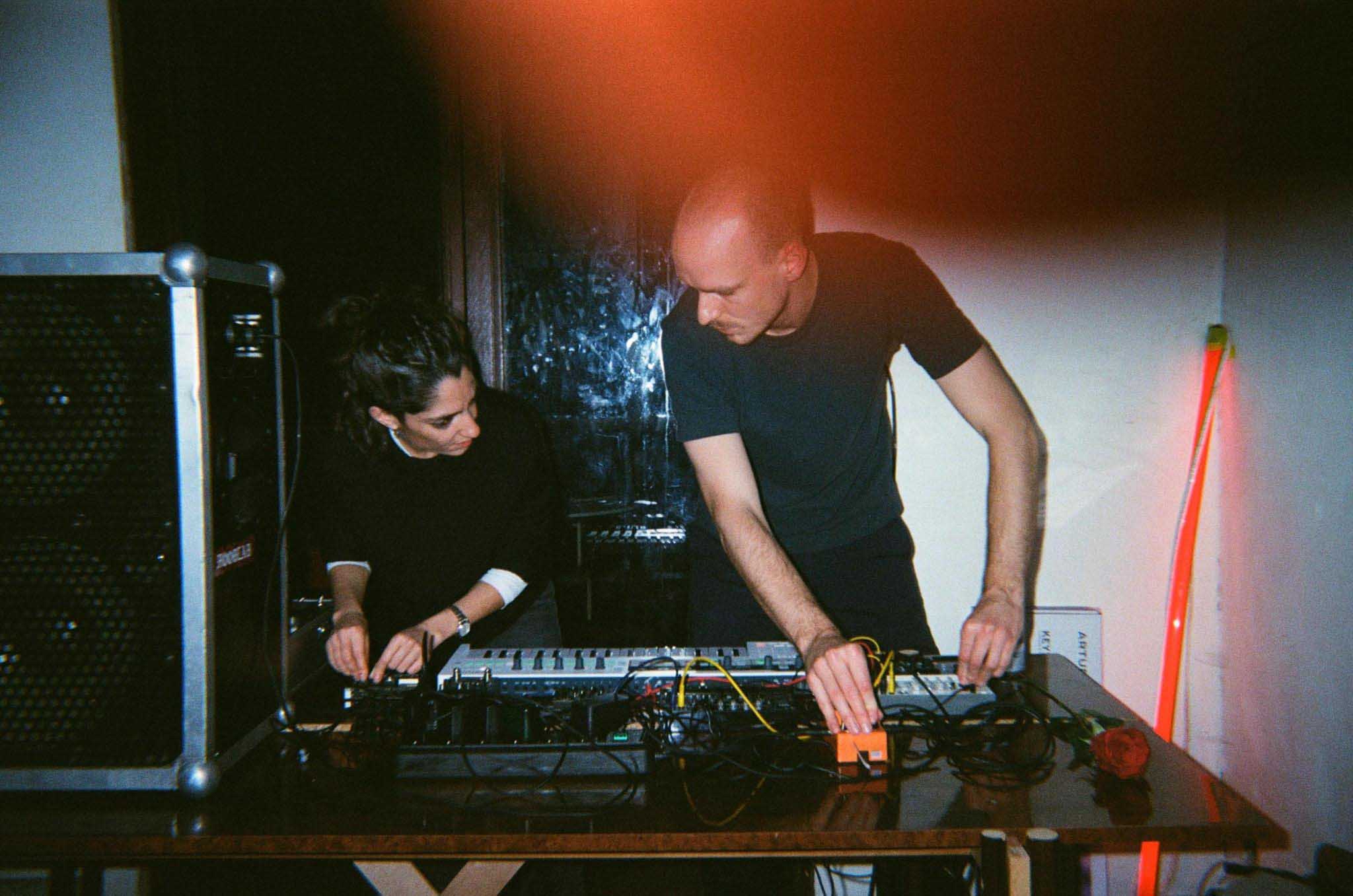
no backup is a live electronic music performance that explores the conditions under which a collective forms through the sustained, physical experience of rhythm. By unfolding within an extended, non-productive temporality, the performance proposes a mode of shared presence outside market logics.
It draws on the reflections of Mark Fisher regarding acid communism, treating music as a potential vector of collective consciousness capable of reactivating forms of political desire. Within this provisional space, the collective does not precede the gathering of bodies; it emerges in the very moment bodies synchronize, patterns repeat, and individual temporalities dissolve into a common pulse.
| Image of the floating world | 2021 |
| Illustration |
Exhibited at the Pavillon de l'Arsenal (Paris) and published by the Pavillon de l'Arsenal and Wildproject publishing houses |
“The apps on our smartphones have not only transformed our uses of urban space into user experiences: they have altered our point of view on the city by inserting themselves as indispensable interfaces, without which we would no longer be able to fully see it.”`
— Soline Nivet, Dans le contre-jour de nos applis, in La Beauté d’une Ville, 2021.
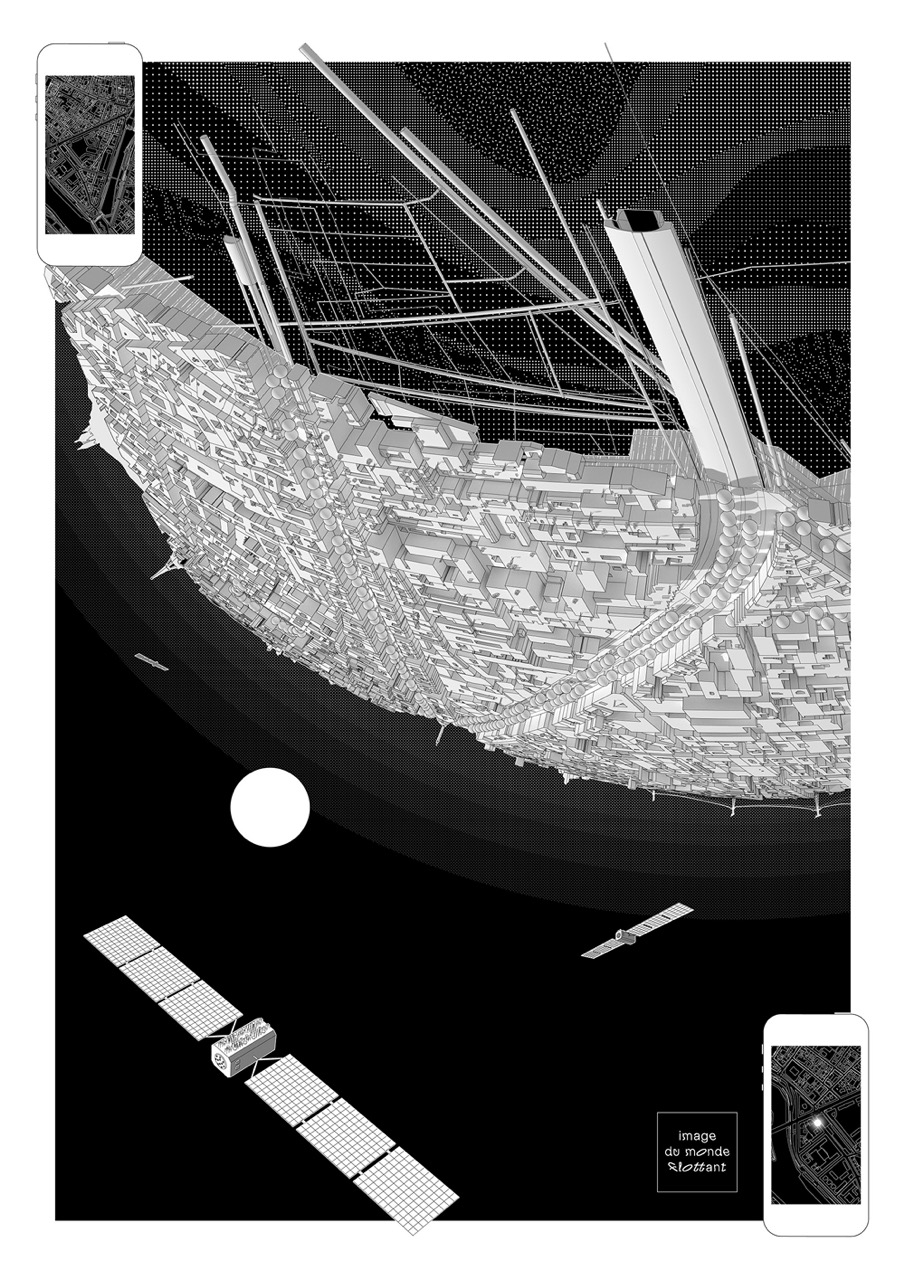
The illustration Image of the Floating World was produced to accompany the article Dans le contre-jour de nos applis, written by Soline Nivet for the exhibition and publication La Beauté d’une Ville, a collective reflection initiated by the Pavillon de l’Arsenal in anticipation of the evolution of Paris’s Local Urban Plan toward a bioclimatic PLU.
To represent the multiple infrastructural layers involved in digital technologies, we adopted an aerial and inverted viewpoint, as if observing from orbit. Moving away from architectural-scale drawing toward a more illustrative style allowed us to assemble the various actors within a single scene. The composition draws inspiration from ukiyo-e prints (“pictures of the floating world”), both in its depiction of a boiling, impermanent urban condition and in its layout, incorporating cartouches in the form of smartphones.
| Host to host | 2020 |
| Article |
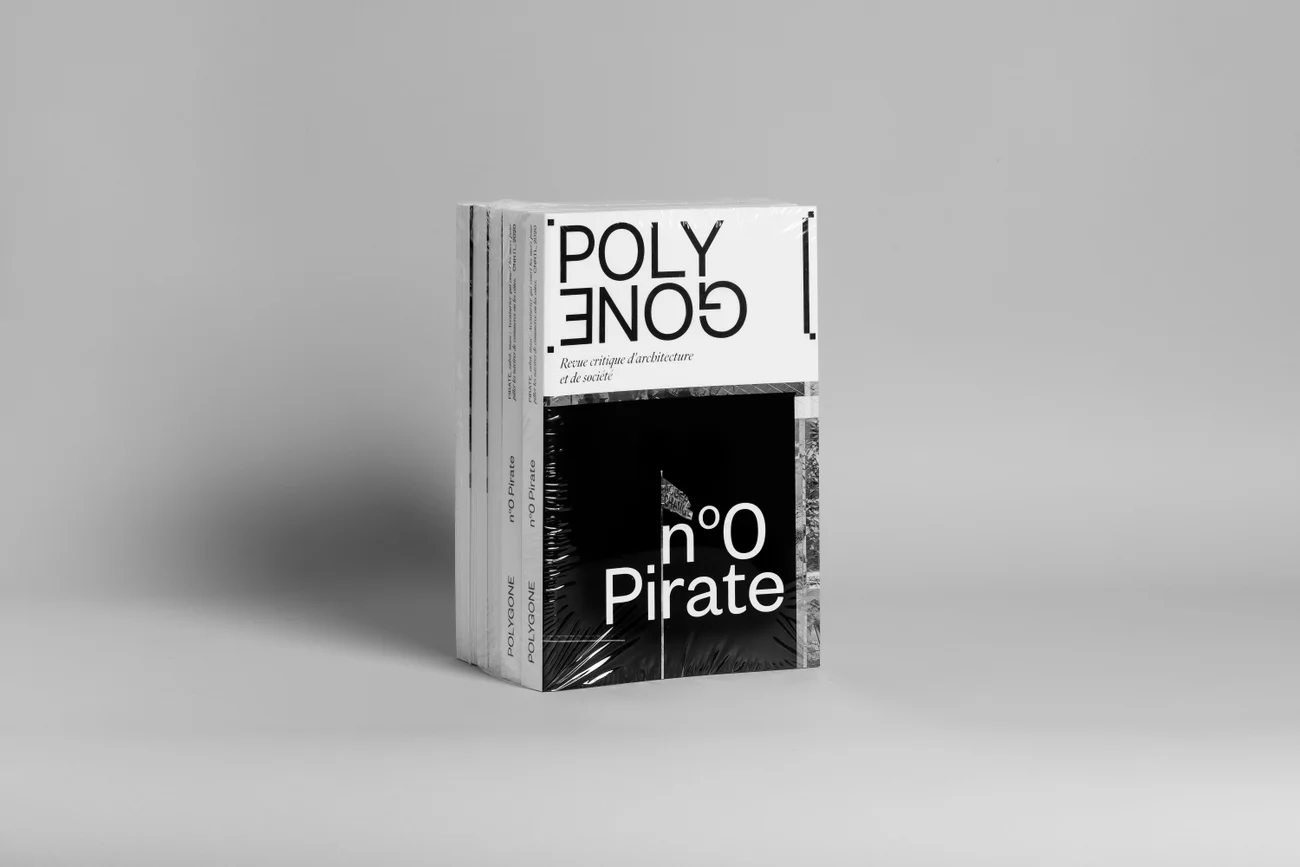
Published in Revue Polygone |
Download the article (French version)
“The same is true for a whole segment of society, which tends to consume without knowing, to find without searching. To understand is to appropriate the object of knowledge through knowledge itself. In this context, hacking is not fundamentally a breach of the legal framework, but an appropriation through understanding. It is the possibility of diversion, a potential emancipation. (…) Striving toward mastery of our tools (…) means building our independence and making our voices heard.”
This article reflects on the growing dependence on proprietary digital tools, particularly within architectural practice, and on the necessity of reclaiming their internal logics. By revisiting the origins of the internet — initially conceived as a space for the exchange of knowledge — it highlights its drift toward passive and standardized uses, dominated by consumption and the commodification of attention.
Far from an illegalist imaginary, hacking is presented here as a practice of knowledge: technical understanding and the redirection of dominant uses. The article draws on a concrete example — a short open-source script written in Ruby that automatically extracts the contact details of French members of parliament. Through this tool, it demonstrates how mastery of programming languages can become a vector of independence and political agency, restoring to individuals the capacity to understand, act upon, and contribute to the evolution of their tools.
| preHistories, access to open objects | Since 2020 |
| Research |
Unpublished |
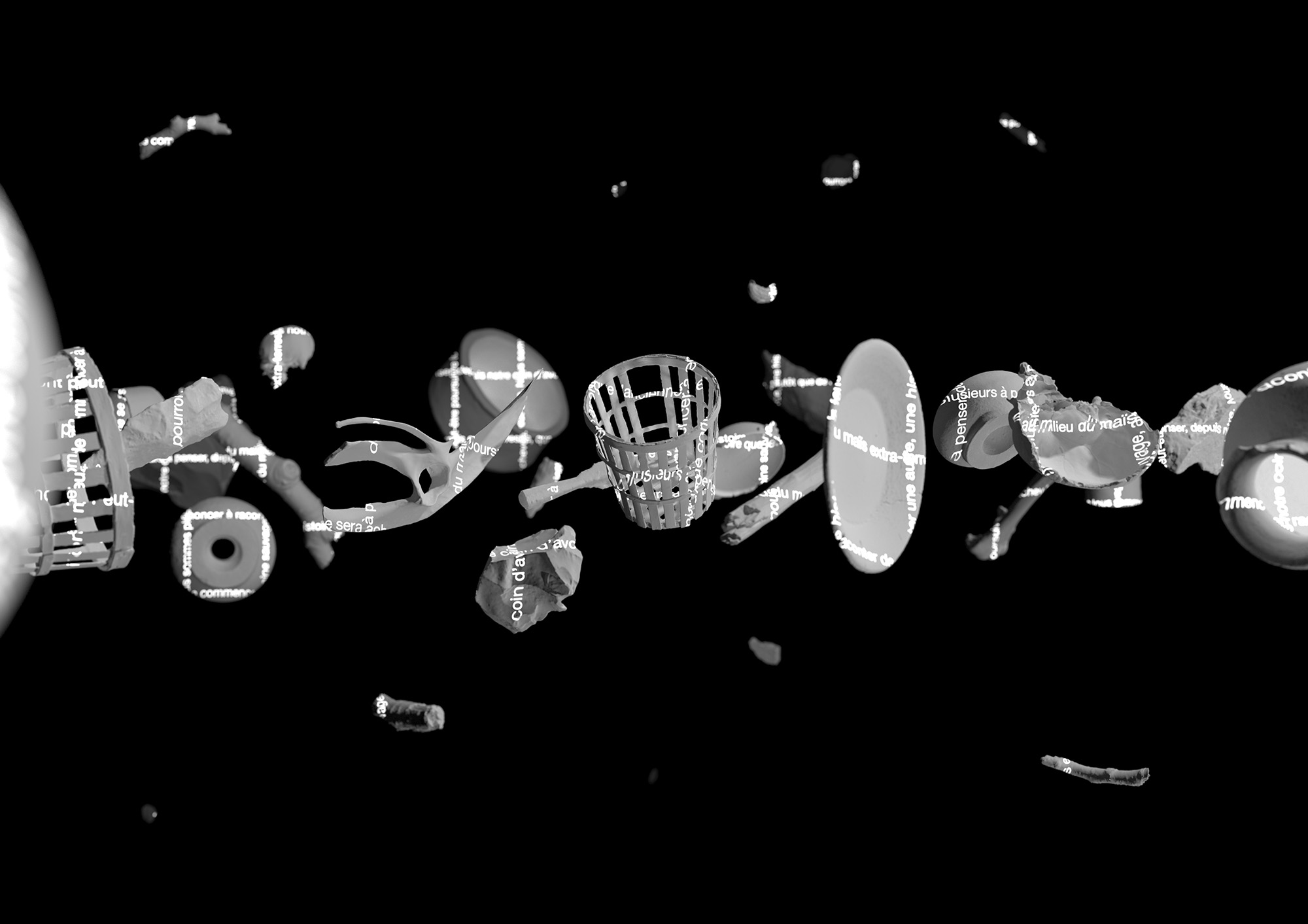
“Having become a taut thread oriented toward the future, the roots of History reveal a beginning that is in fact plural and diachronic. Generally considered the corollary of the birth of writing, it would appear at points separated by hundreds of kilometers and years, across a world where trade and the State were taking shape. Thus, prehistory would be the period between the emergence of humankind and History. An illusion of a biblical genesis from a single, pure, luminous point — yet in truth diffracted. There is no cradle of humanity resembling the Garden of Eden. The human is, by essence, hybrid.”
Humanity has moved from the fatality of a knowable and prewritten future, to the determinism of a future governed by scientific rules. It has more recently entered the uncertainty of an unknown future — one that can nonetheless be altered. Within this uncertainty lies the potential for change.
If architects are to fulfill a public-interest role, they must engage disciplines beyond their own. Stone cannot be the sole instrument with which to construct the future. There is also Law, History, Fiction, bodies, objects, techniques, revolts, beliefs, ecosystems, and climate.
To approach open objects is to cultivate curiosity in all circumstances. It is to question continuously, and to begin understanding any object of study by first opening it.
| Uncertainty and chaos | 2020 |
| Article |
Published by the Pavillon de l'Arsenal |
Download the article (French version)
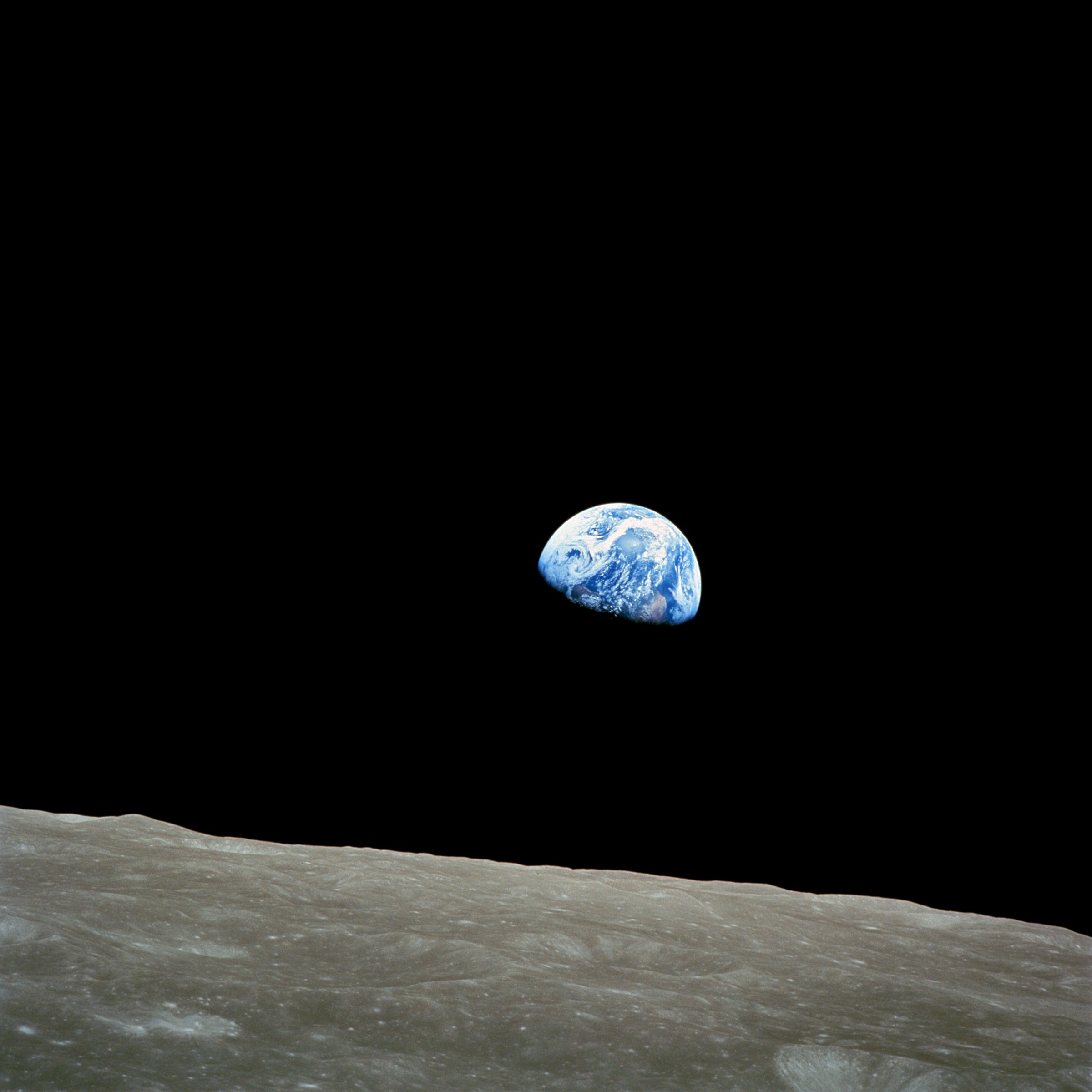
This article — written in the context of the first lockdown — examines the narratives transmitted across generations in the face of the unfulfilled promises of progress. Beginning with the intimate memory of the first step on the Moon, it questions the gap between projections of a pacified future and the reality of a world in permanent crisis. The lunar event becomes a symbol of an illusion of mastery and order, now confronted with climatic, social, and political instability.
As institutional responses increasingly translate into heightened control, the article calls for collective awareness: the crises to come will not be spectacular but diffuse, continuous, and systemic. Living with uncertainty requires a profound shift in how we perceive, think, and act. It is no longer a matter of waiting for a return to normal, but of inventing other ways of inhabiting the world, in rupture with dominant narratives. Chaos is no longer an external threat; it is a condition of the present — and perhaps an opportunity for transformation.
| Measuring and piling, fiction and reality | 2019 |
| Installation, short film, 11 minutes |
Exhibited at the Pavillon de l'Arsenal (Paris, 2020) and at the Miroir (Poitiers, 2021) |
Download the script (French version)
“It is in the combination of perceptions and measured values of the Real that reality emerges. The human obsession has been to model and measure the Real. This modeling, initially fictive, gradually merges with ambient reality in order to organize it, qualify it, justify it. (…) The pile remains what is underestimated. It is the form taken by any object at the limits of our world, whether unexplored or rejected. The pile exists between worlds; it does not count. It is an amorphous, ghostly object that sometimes comes back to haunt us. Neither dead nor alive, it waits.”
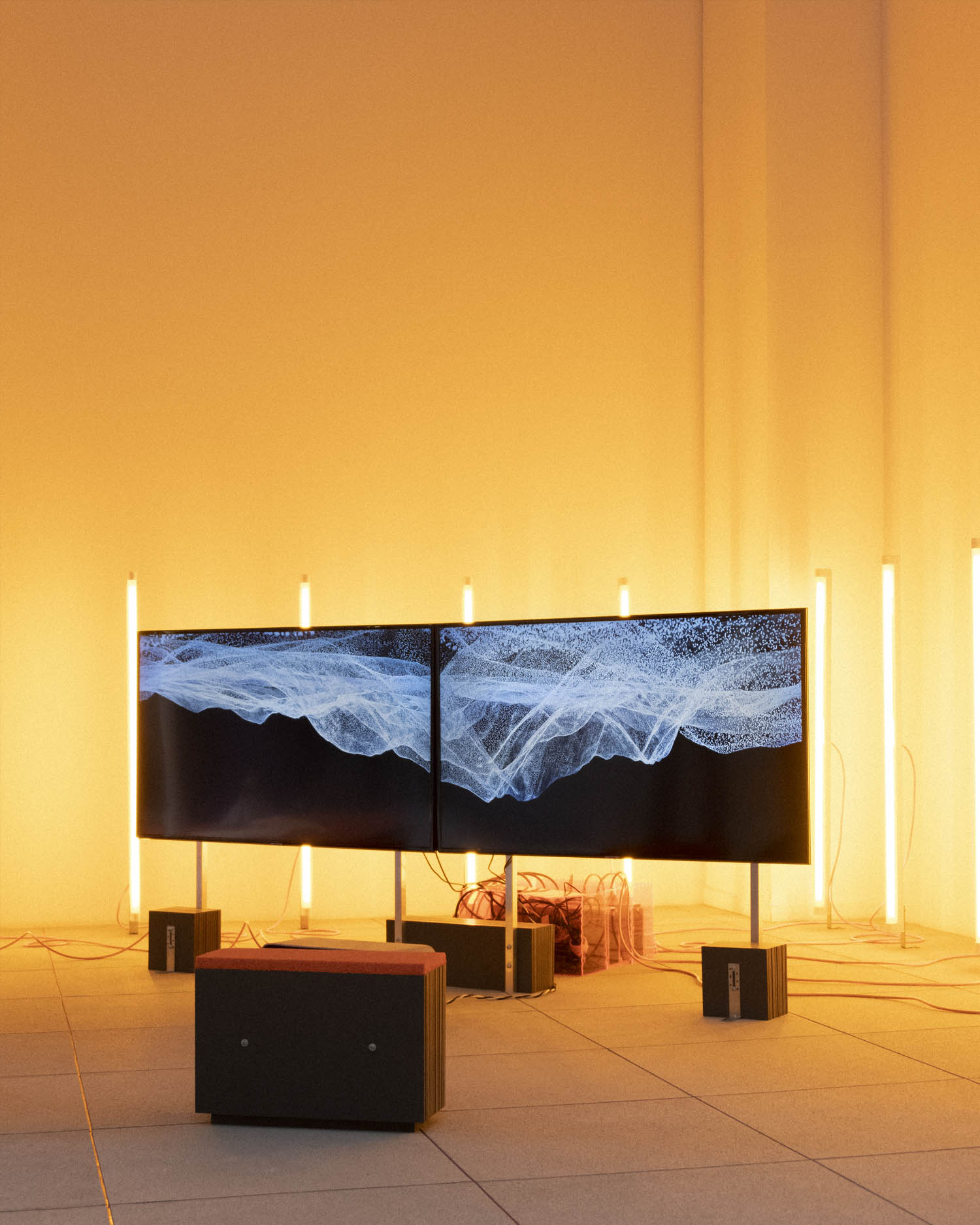
Measuring and piling, fiction and reality is a video installation addressing the obsession with measurement. It draws on cross-disciplinary research combining interviews, audio recordings, writing, sound composition, and photogrammetric scans.
In a neo-tribal scene illuminated by orange neon light, three low seats are arranged around a dual-screen structure from which narratives of humanity’s fixation on measurement are delivered. The installation forms an assemblage of synchronized media and original objects conceived specifically for the project.
| Random Architecture Program | 2019 |
| Computer program |
Published on generator.mlav.land |
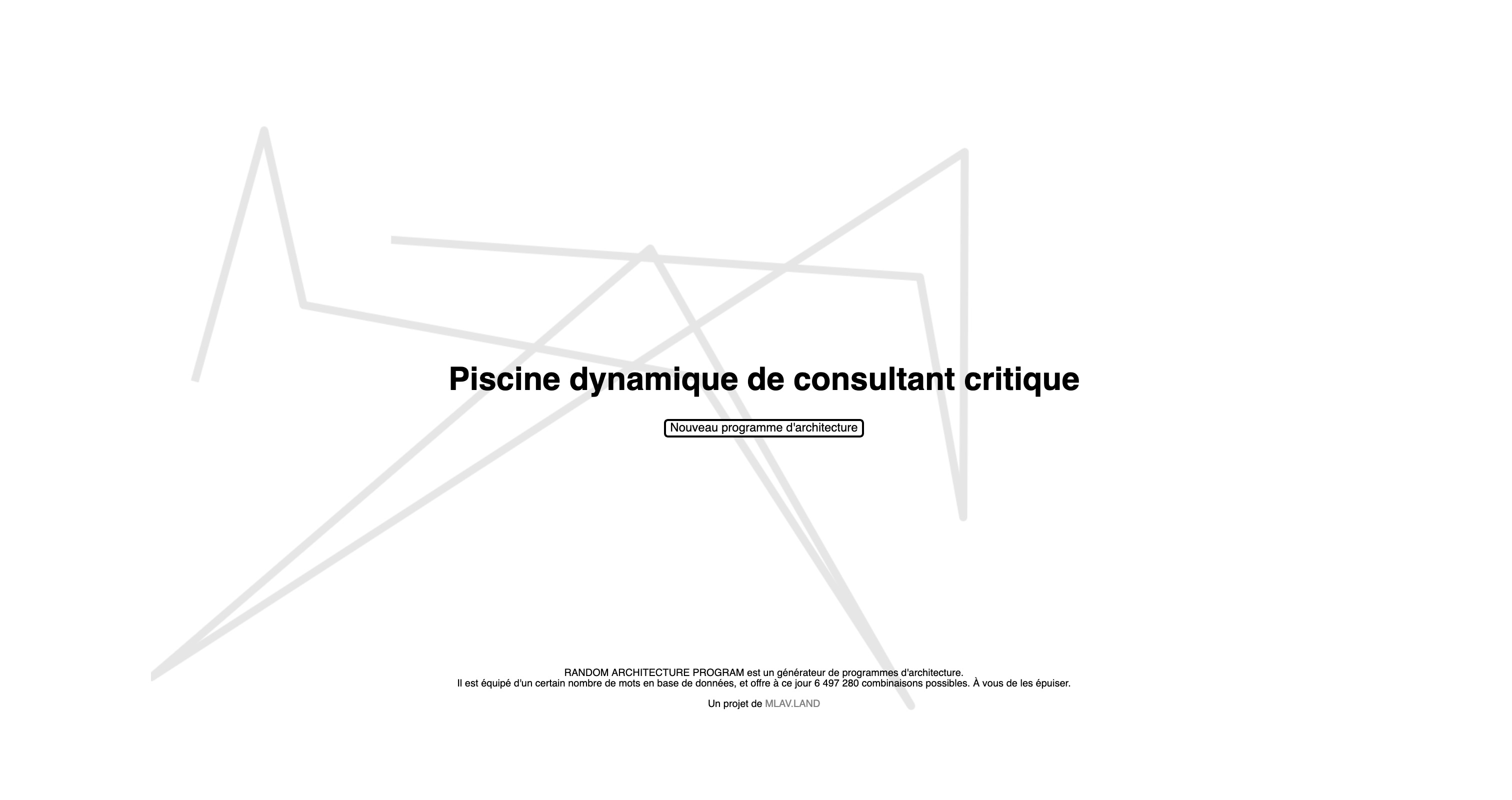
The Random Architecture Program proposes a playful and critical approach to architectural programming. Based on a corpus of words, it can randomly generate more than 6.4 million combinations.
By diverting the codes of architectural language, this generator questions the way narratives and stereotypes shape our built imaginaries. It exposes the arbitrariness of certain conventional associations between forms, functions, and social figures. By introducing unpredictability through random pairings, it creates openings within the standardization of programs and invites architecture to be reconsidered as a field of fictional experimentation.
| Actualization of heritage | 2019 |
| Article as part of an ideas competition |
Photo : © Julian Abrams |
|
Special mention from the jury |
Download the article (French version)
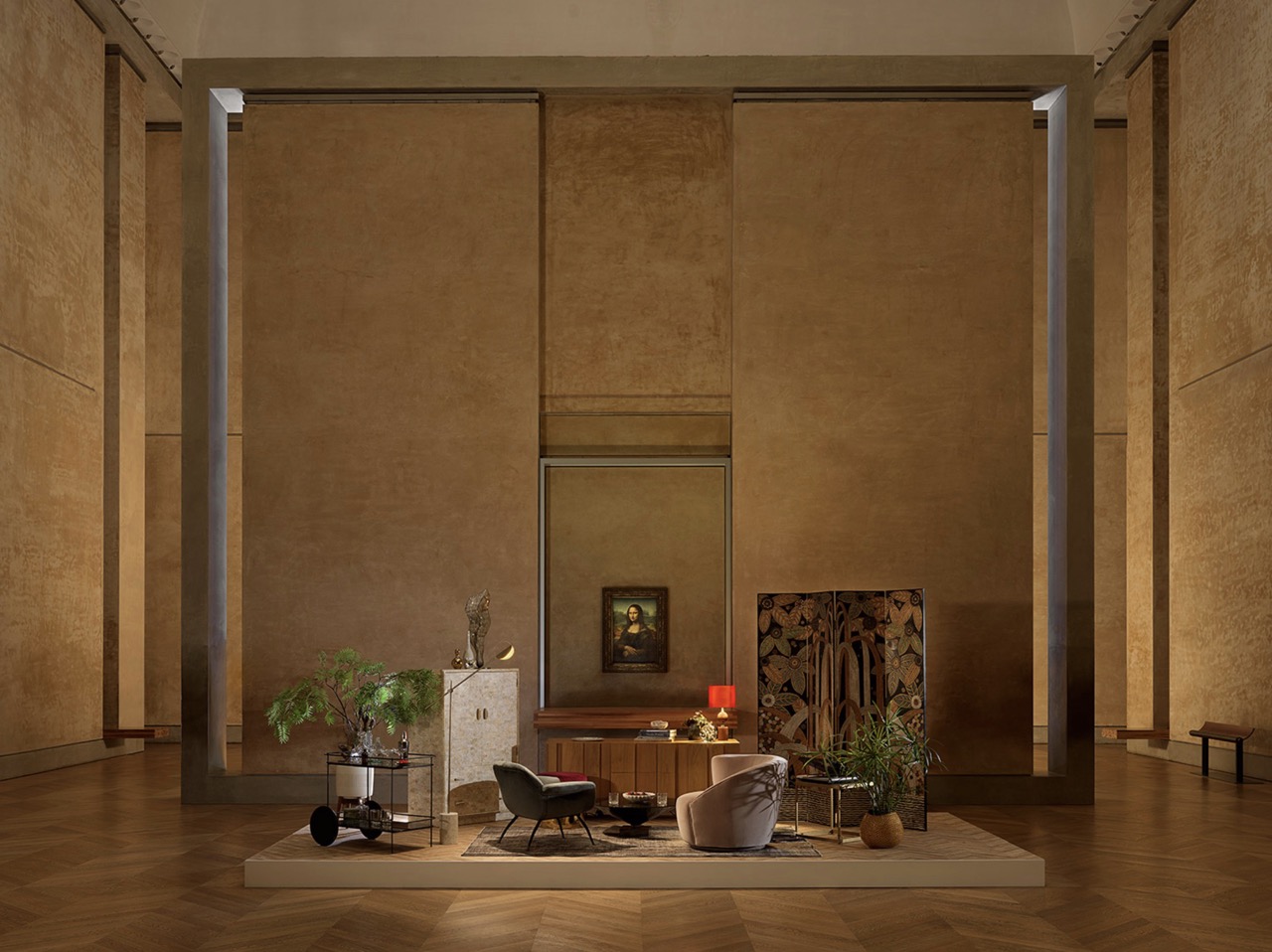
This project develops a critical reflection on the evolution of heritage in the digital age and under conditions of ecological urgency. Architecture, once a bearer of collective memory, is increasingly relegated to the status of aesthetic object, emptied of its historical significance.
The text questions this shift: what becomes of a monument in a world saturated with images, where memory fragments into data? It addresses forms of heritage in transformation — preserved nature, digital memory, ruins as stigmas, and the growing privatization of historically charged sites. The Chambre des Notaires de Paris embodies this paradox: a place of living memory, yet not a monumental landmark. Its transformation raises the issue of transmission not through stone, but through the notarial act itself.
The project thus proposes a redefinition of heritage: less an object to be preserved than a living, shifting process — sometimes immaterial.
| The Iliad/Free ecosystem in Paris | 2019 |
| Illustrations |
Published in Revue du Crieur #20 and in Paris Ville Free (369 éditions) |
|
Ordered by Soline Nivet |
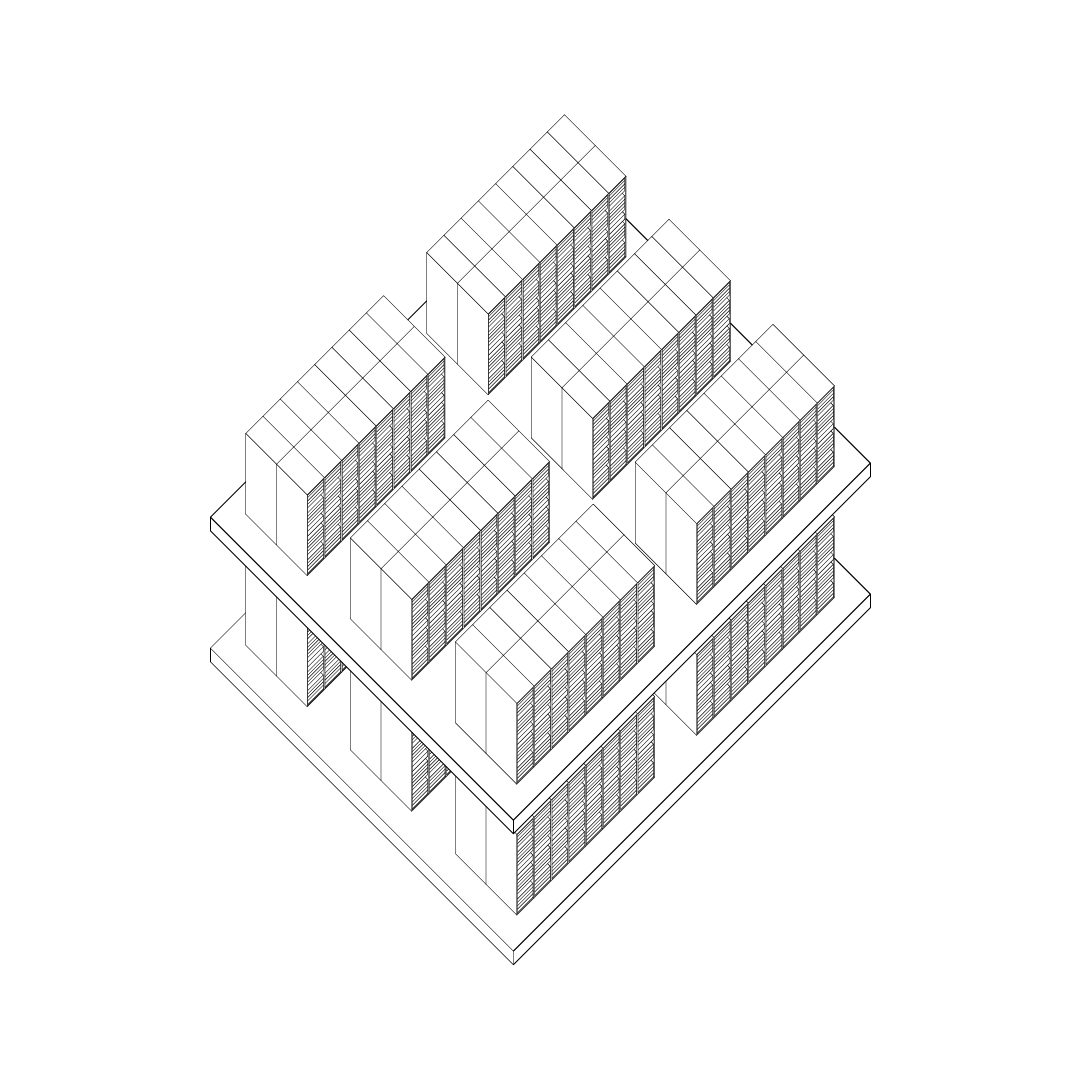
These illustrations accompany an investigation into the strategic sites occupied by subsidiaries of the Iliad/Free group, at the intersection of digital infrastructure, discreet architecture, and private urban production.
The drawings present a subjective cartography of the buildings in question, revealing their forms, locations, and the dynamics they activate within the Parisian urban fabric. Their aim is less to document faithfully than to interpret, highlighting the logics through which these spaces are appropriated: densification, erasure, and the staging of economic power.
| Objects trump architecture | 2019 |
| Article |
Published on the forwward platform |
The definition of the consumer society given by Jean Baudrillard in 1972(1) evokes a profusion, a pile up, an overabundance of objects. From this point of view, the major legacy of the 20th century is a continual denial of rarity. From a symbolic object we moved to a functional and disposable object. It became the element of a system, composed of signs. It is now a disenchanted, deterritoralized, teleported object without origins. From abundance to overload, the logic of objects has gradually changed to a race with renewed functionality, efficiency, adaptability, sometimes going as far as absurdity and uselessness.
Andrea Branzi pointed this evolution in figures: "We can suppose that at the beginning of the last century, a family of four moderately well-off people was surrounded, in their own house, by a system of objects composed of 150 to 200 elements at most, including dishes and clothes. Today, it has a system of about 2500 to 3000 items, including home appliances and amenity items. Except books, records and other cassettes."(2) The panoplie, the thing, the trick, the gadget, the trinket ... The contemporary built space is invaded by objects that we don’t even know how to name. With this preponderance that objects have taken on the architecture, our modes of living have become dependent on a certain number of functionalities, offered by them.
Today, it is a new paradigm that presents itself with the case of the connected object. The thing is becoming a machine. A condensed technicality of new functionalities, coming into interrelation with other connected objects, aiming to create a synthetic and intelligent biotope. Objects that populate our homes, our workplaces, our ordinary surroundings come into contact with our body according to different orders. A cluster of devices, integrated into contemporary constructions as well as in old buildings. It is important to note that what defines our relationship with space today is not so much what we inhabit in, what we live in. But what we live with, and what we inhabit with. It is no longer the place that marks the relationship of a person with his environment, but the relationship with the things that surround him. It is a relationship of control from users on objects.
Formerly associated to possession and inheritance, the object is now in a race to update, to a superior efficiency of a new model. The temporality of objects has changed from life time to usage time. Precisely refined usage, to define an abstract gesture of control(3). The effort is becoming increasingly rare in a habitat where automation enters, diffused in each bulb, electrical appliances, thermostat, etc. The processing of information dissolves in spaces and objects of our environment through miniaturization and the increase of computing capacities. With fingertips, we are able to activate, deactivate, vary the functions of our surrounding objects. The transition to connected objects reduces this gesture more and more to a minimum effort. A precise knowledge of our daily life by objects that compose it. This intelligence is a turnaround of the situation: a relationship of control from connected objects on users.
Thus, the contemporary model expresses itself no longer through the immutable form of architecture but through the versatility of the object. In a world drawn by capital production and aiming for an intelligent ecosystem, the object trumps architecture. Its updating capacity being irremediably faster and global.
Thanks to computation, time has found its place in the genesis of design. But once the architecture is built, all its dynamics related to the design process disappears. It remains fixed in one of the algorithmic solutions of a moment T. Yet the time and the environment in which this architecture borns will not be fixed, but will continue to tirelessly evolve. Any update requires a transition from the virtual to the actual that the built architecture can no longer achieve. However, the ecosystem of objects that inhabits it is updated on two levels. An update of the software, which is characterized by downloading an upgraded program. Or an update of the hardware that occurs when technological innovation has changed the material components of the object, and invokes its physical change.
This model of continuous renewed consumption is part of a marketing that aims to build a constantly renewed desire, in accordance with the foundations of the consumer society. The continuous architecture of the city is distorted by objects that inhabit it. It is no longer produced a priori but participates in the heterogeneity of the local space-time relative to each object by connecting them. Each one develops in relation with those surroundings, implying a system of atmospheres. Architectural discipline must question and mingle with objects, which erase and recompose it.
In 1967, Guy Debord wrote in La Société du Spectacle that "the accumulation of mass-produced goods for the abstract space of the market [...] must also dissolve the autonomy and the quality of the places."(4) This dissolution of everyday life spaces in objects forces us to rethink the quality, mood and perception of our environment.
(1) BAUDRILLARD Jean, 1972. La Société de Consommation. Editions Denoël.
(2) BRANZI Andrea, 1988. Nouvelles de la Métropole Froide. Paris : Editions du Centre Pompidou, 1991, p. 26.
(3) “When grasping objects that interested the whole body, contact (hand or foot) and control (gaze, sometimes hearing) were substituted. In short, only the “edges” of the body actively participate in the functional environment.” - BAUDRILLARD Jean, 2016 [1968]. Le système des objets. Paris : Gallimard, p.69.
(4) DEBORD Guy, 1967. La Société du Spectacle. Paris : Folio, p. 103.
| The mobile micro-laboratory | 2019 |
| Mini Maousse 7 micro-architecture competition |
Exhibited at the Cité de l’Architecture et du Patrimoine (Paris, 2020) |
|
Special mention from the jury |
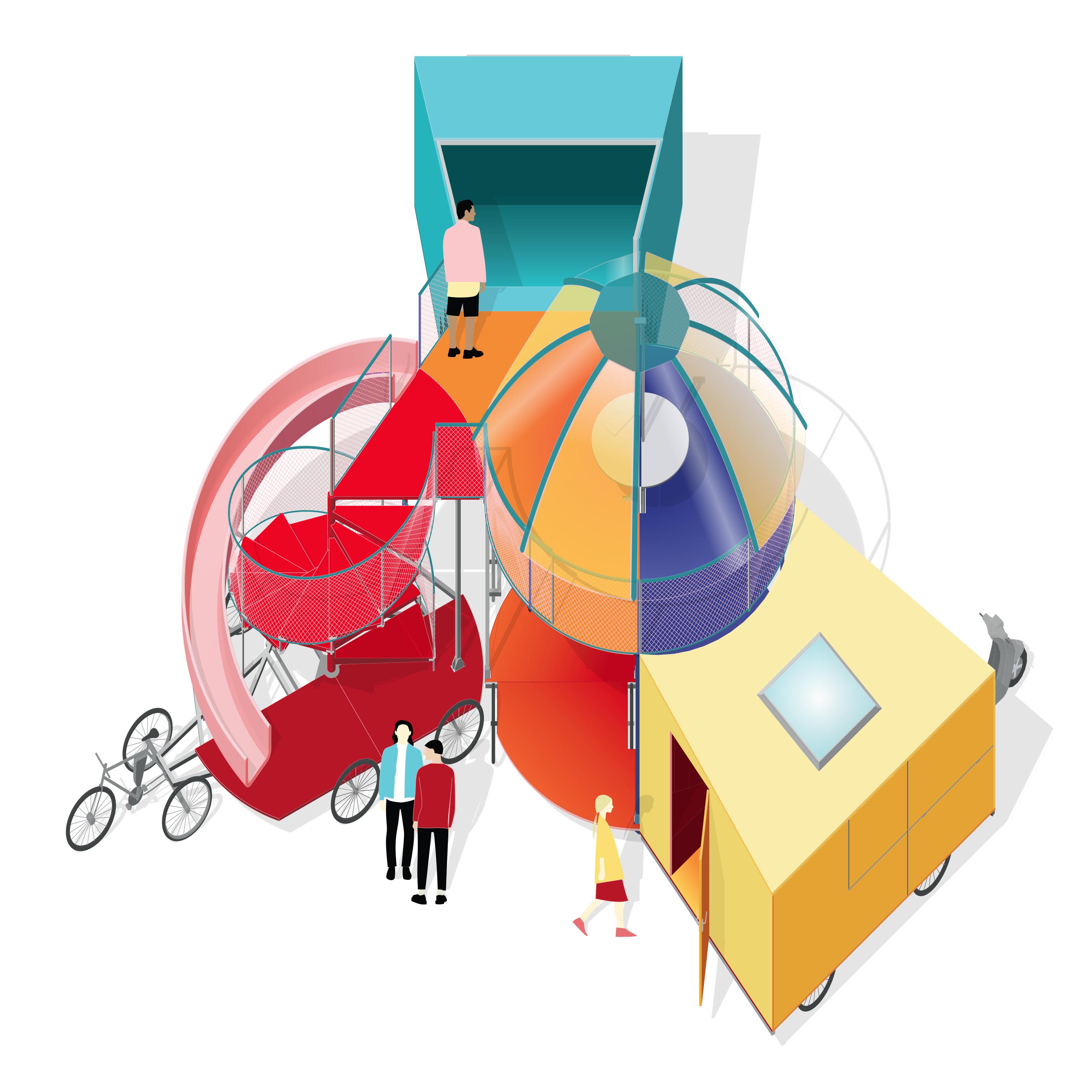
Conceived as a mobile micro-architecture, this lightweight and modular structure is composed of five units towed by bicycles and electric vehicles. It moves slowly between different localities and installs itself temporarily — from a few days to several weeks — within public spaces.
At each stop, it anchors itself in local realities by establishing direct dialogue with residents. Designed as a mediation tool, the micro-laboratory provides material and educational resources addressing digital issues, adapting its interventions to needs identified on site. It functions as a space for support, transmission, and networking, combining physical interventions with remote follow-up through a dedicated online platform.
This mobile architecture assumes a dual role: a concrete presence within the territory and a virtual extension. It seeks to strengthen connections between underserved areas and digital resources, while questioning conditions of accessibility, sharing, and autonomy in a context of persistent social and technological divides.
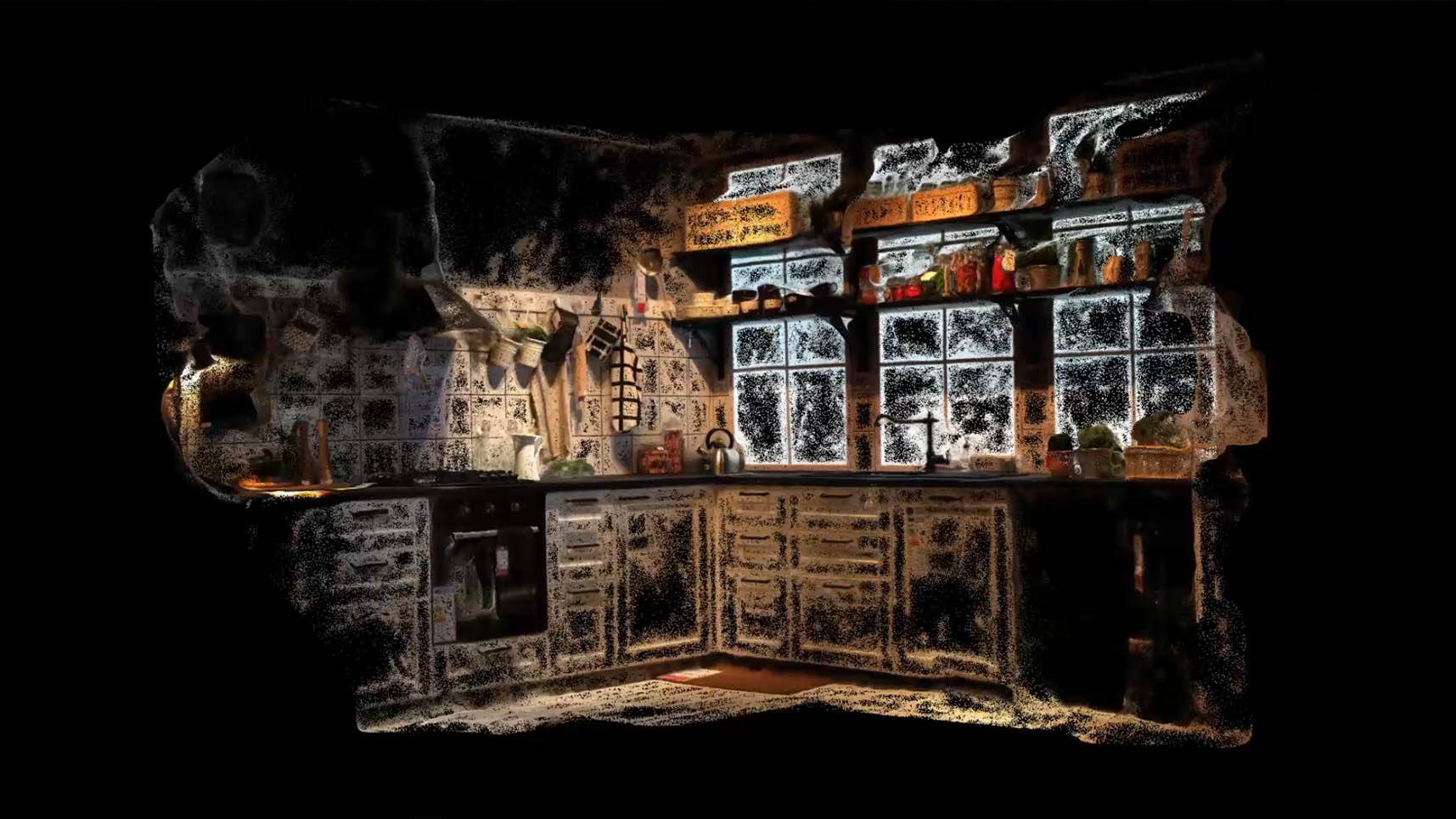
| Archives of terrestrial extracts | 2019 |
| Archiving project, photogrammetry |
The Archives d’Extraits Terrestres (AET) is a spatial archiving project that explores the potential of 3D technologies to capture, preserve, and transmit constructed fragments of everyday life. Contrary to conventional uses of 3D scanning — often reserved for recognized monuments or artworks — this work focuses on documenting the ordinary: transitional places, vernacular architectures, and anonymous spaces that nonetheless carry use, memory, and lived experience.
Through the collection of built elements, the AET outlines an archaeology of the present. This process transforms the way heritage is perceived: it is no longer age that confers value, but contemporary resonance. By enabling rapid, dense, and precise capture, digital tools compress historical time and make immediate patrimonialization possible.
The project thus questions our relationship to trace and archive, and the ways in which shared space becomes memory.
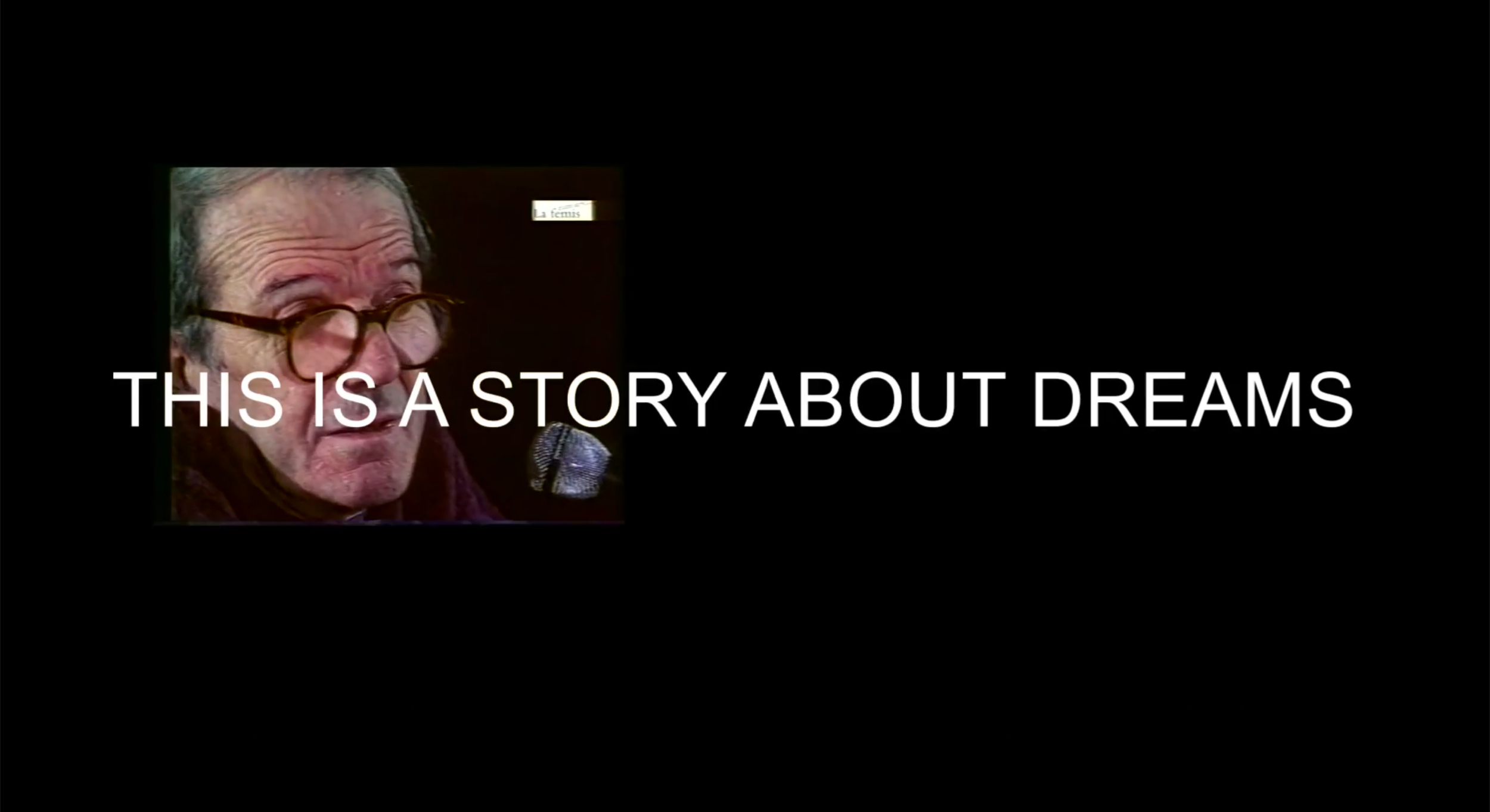
| This is a story about dreams | 2018 |
| Talk, short film, 13 minutes |
ENSA Paris Malaquais |
This Is a Story About Dreams is a short film that documents and interrogates the process leading to the realization of the project What it can be. The film operates as a critical space in which the design method itself becomes the object of analysis.
It opens with an excerpt from a lecture by Gilles Deleuze at La Fémis, in which he warns against “the dream of the other” — a dream that engulfs and captures, and within which it is fatal to become lost. This framing immediately raises the question of subjectivity in the project: who dreams, who is subjected to the dream, and under what conditions can one claim one’s own narrative and construction of the world?
From this point, the short film retraces the genesis of the initial architectural project. It follows the emergence of a space generated by tooled bodies — equipped, quantified, translated into data. The film reveals a technicized design process in which dreams are sometimes delegated to systems, and at other times dictated by them.
In a world saturated with automated narratives, the film asks how one might avoid becoming trapped in the dream of another — even when that dream is generated by an architecture that has itself become an interface.
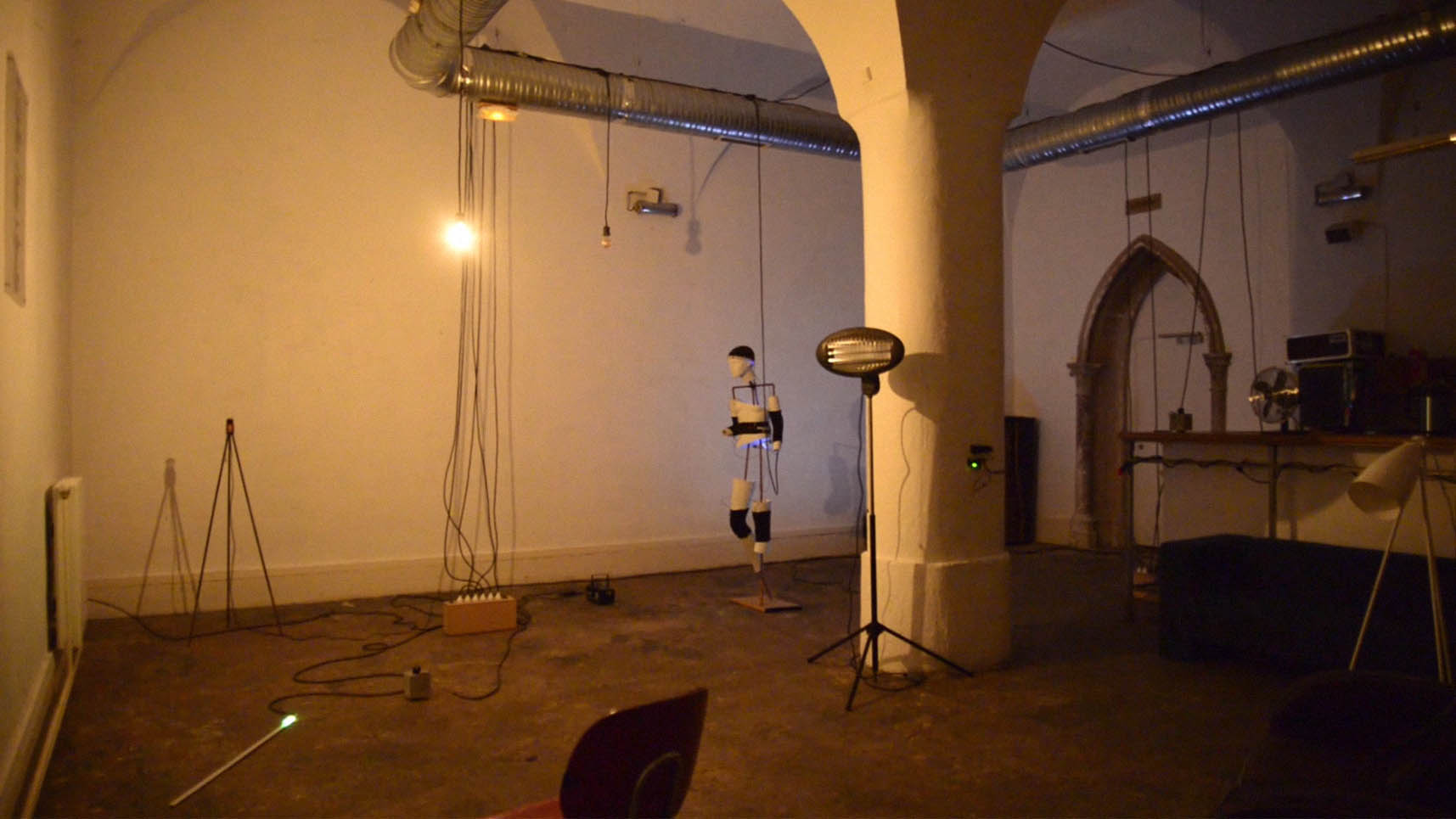
| What it can be | 2018 |
| Installation, short film, 15 minutes |
ENSA Paris Malaquais, Digital Knowledge department |
What it can be is an architectural installation that examines the transformations induced by the digitization of bodies and environments. Sensors record physiological data, which are translated into spatial atmospheres: the body becomes signal, the space becomes interface. This shift from a language of experience to an informational language exposes a central tension — between lived subjectivity and objectified data.
Technology is approached here not as a neutral tool but as a language in itself: a normalizing abstraction that precedes and conditions experience. Architecture, once a site of symbolic inscription, becomes a logistical, reactive, programmed support. Human memory — shaped by forgetting and reconstruction — is confronted with machinic memory, inalterable and exhaustive, without silence or blur.
The project thus interrogates the dispossession of sensibility in favor of an automated regime of reading the real. It proposes inhabiting the gap between signal and sensation, asserting opacity in the face of totalizing transparency. If everything becomes legible, measurable, predictable, what remains of the unforeseen, of disturbance?
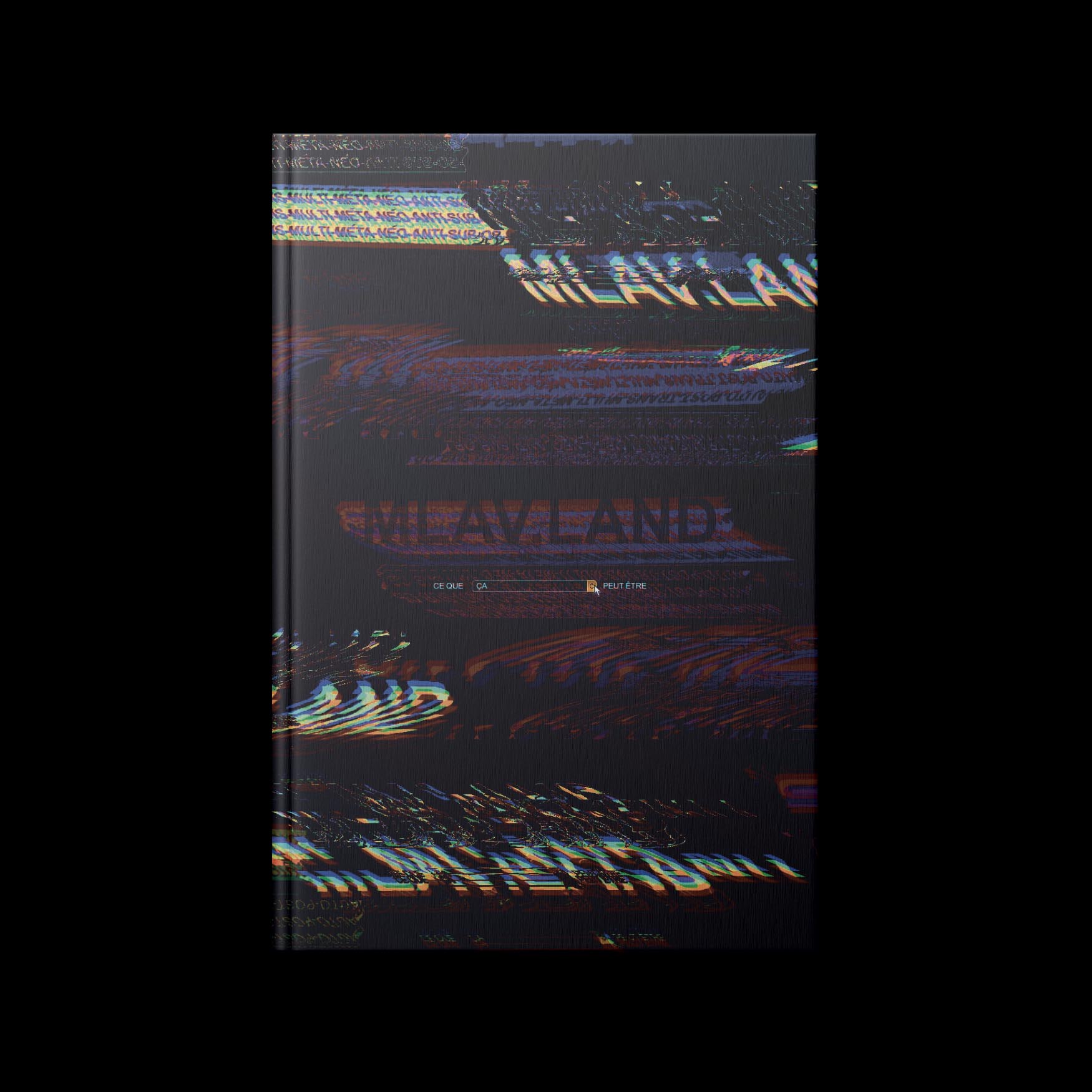
| auto-post-trans-multi-méta-néo-anti-sub-ob- | 2018 |
| Diploma thesis |
ENSA Paris Malaquais, Digital Knowledge department |
In the second chapter of the fifth book of Notre-Dame de Paris, Victor Hugo titles his argument “Ceci tuera cela” (“This will kill that”), asserting the growing dominance of print over architecture. Technical reproducibility, he argues, transforms knowledge: once inscribed in architecture — symbolic, static, contextual — it becomes volatile language, reproducible in the form of the book. The language of buildings becomes portable, diffusible, translatable.
The machine, as an extension of human operative power over the environment, continues this externalization of knowledge in another form. This continuation is marked by the emergence of a new language added to those that preceded it: the language of data. It overlays the world with a grid capable of naming, recognizing, and measuring it. The shift from a human language-knowledge to an instantaneous machinic informational language leads to the preexistence of information over knowledge and lived experience.
The difference in nature between human memory and machinic memory lies primarily in the human capacity to forget and to perpetually reinterpret recollection. Experience, inscribed in bodily memory, can be transmitted through language, but only as a reinterpretation — perception compressed and expressed.
A part of subjectivity remains intrinsically bound to bodily memory: purely individual, dependent on the body itself. Experience is therefore subjective, composed of singular perceptions. It is to this fragment of subjectivity — this individual force immersed within a homogenizing objectivism — that we seek to attend.
| The Dive | 2017 |
| Short film, 15 minutes |
Exhibited at the Beaux-Arts School (Paris) |
|
In collabration with Armelle Martin-Richon |
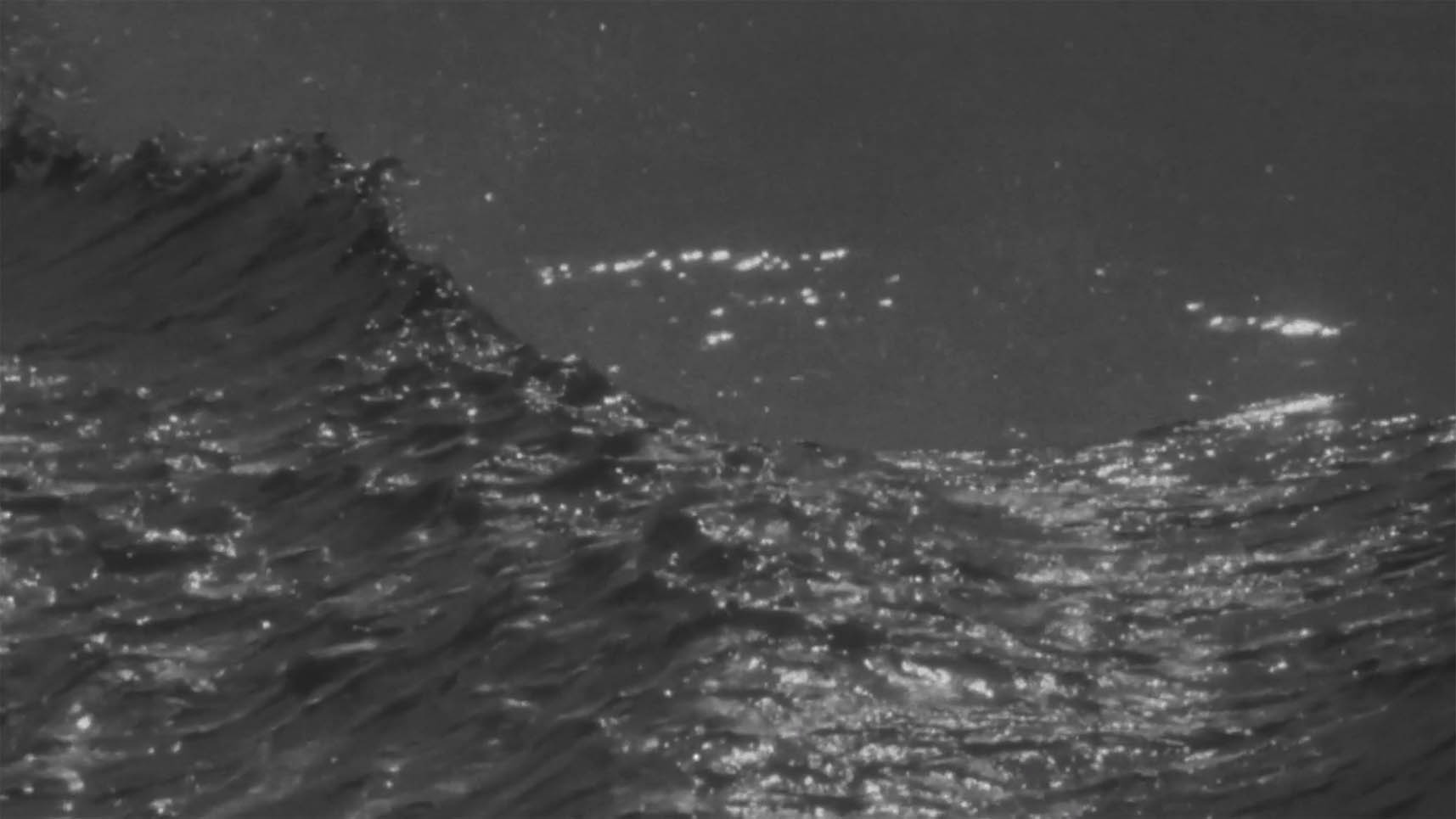
The Dive is a fictional short film inspired by real events, retracing the history of architectural education and the profession from 1968 to the present.
Drawing on archival material, an interview with sociologist Jean-Louis Violeau, and research into the uprisings of May 1968, the film highlights the rupture between the École des Beaux-Arts and the newly established Schools of Architecture, before, during, and after the events.
To give form to this historical narrative, the film adopts an environmental metaphor: a slow flood gradually submerges the world of the Beaux-Arts, sweeping away its institutions, methods, and legacy, allowing new structures to emerge. These structures profoundly redefine the transmission of architectural knowledge, as well as the frameworks governing and legitimizing the profession, within a landscape reshaped by the ideals of 1968. Yet beneath the surface, certain lines remain unexpectedly familiar.